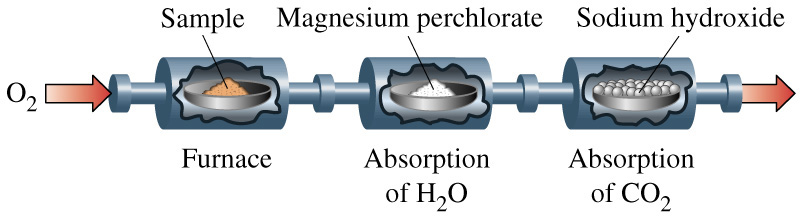
Menthol, the substance we can smell in mentholated cough drops, is composed of C, H, and O. A 0.1005 g sample of menthol is combusted, producing 0.2829 g of CO2 and 0.1159 g of H2O. What is the empirical formula for menthol?
0.2829 g of CO2 x
1 mol CO2
=0.006430mol CO2 x
1 mol C
=0.006430 mol C
44.0g CO2
1 mol CO2
0.1159 g H2O x
1 mol H2O
=0.006439mol H2Ox
2 mol H
= 0.01288 mol H
18.0g H2O
1 mol H2O
Now we need to convert the moles to grams of these elements
0.006430 mol C x
12.0g C
=0.07716 g C
1 mol C
0.01288 mol H x
1.0g H
=0.01288 g H
1 mol H
Find the mass of Oxygen by subtracting the C and H from the total mass of the sample
Total= mass C + mass H + mass O
0.1005g= 0.07716 g C + 0.01288 g H +mass O
mass O= 0.01046g O
Convert to moles of O
0.01046g O x
1 mol O
=0.0006538 mol O
16.0 g O
Finally find the mole ratio by dividing by the smallest quantity
Empirical Formula C10H20O
0.006430 mol C/ 0.0006538 =9.83≈ 10
0.01288 mol H/ 0.0006538 = 19.70 ≈20
0.0006538 mol O/ 0.0006538 = 1
Example 2
A 14.1 mg sample of a hydrocarbon was burned in air. The products were 38.8 mg of CO2 and 31.7 mg of water. what is the empirical formula of the hydrocarbon.
Note I am using mmols (it is just moles but smaller)
38.8mg of CO2 x
1 mmol CO2
=0.882mmol CO2 x
1 mmol C
=0.882mmol C
44.0mg CO2
1 mmol CO2
31.7mg H2O x
1 mmol H2O
=1.76 mmol H2Ox
2 mmol H
= 3.5mmol H
18.0mg H2O
1 mmol H2O
Set up a mole ratio by dividing by the smaller of the two
0.882mmol C
/ 0.882mmol = 1
Empirical Formula =CH4
3.5mmol H
/ 0.882mmol = 4
Really nasty example
A 0.2417g sample of a compound composed of C,H,O,Cl only, is burned in oxygen yielding 0.4964g of CO2 and 0.0846g of H2O. A separate 0.1696g sample of the compound is fused with sodium metal, the products dissolved in water and the chloride quantitatively precipitated with AgNO3 to yield 0.1891g of AgCl. What is the simplest empirical formula for the compound.
Sample
Convert to moles
Moles of Compounds
Moles of each element
0.4964g of CO2 x
1 mol CO2
=0.01128mol CO2 x
1 mol C
=0.01128mol C
44.0g CO2
1 mol CO2
0.0846g H2O x
1 mol H2O
=0.00470mol H2Ox
2 mol H
= 0.0094mol H
18.0g H2O
1 mol H2O
0.1891g AgCl x
1 mol AgCl
=0.001320molAgClx
1 mol Cl
=0.001320mol Cl (from 2nd sample)
143.3g AgCl
1 mol AgCl
Set up a proportion for the moles of silver
0.001320mols Cl
=
X mol Cl
X=0.00188moles Cl (in first sample)
0.1696g
0.2417g
Find the grams of each element
0.01128mol C x
12.01 g C
=0.1355g C
1 mol C
Sample MassCHClO
0.2417g
0.0094mol H x
1.00 g H
=0.0667 g Cl
CHCl mass
-0.2117g CHCl
1 mol H
O mass
0.0300g O
0.00188mol Cl x
35.5 g Cl
=0.0094g H
1 mol Cl
TOTAL
0.2117g CHCl
Find the moles of O 0.0300g O x
1 mol O
=0.00187 mol O
16.0g O
Finally find the mole ratio by dividing by the smallest quantity