Heat of Vaporization-the amount of heat required to convert unit mass of a liquid into the vapor without a change in temperature.
For water at its normal boiling point of 100 ºC, the heat of vaporization is 2260 J g-1. This means that to convert 1 g of water at 100 ºC to 1 g of steam at 100 ºC,
2260 J of heat must be absorbed by the water. Conversely, when 1 g of steam at 100 ºC condenses to give 1 g of water at 100 ºC, 2260 J of heat will be released to the surroundings.
Heat of Vaporization of Water Hv = 2260 J /g
q= m Hv
Sample Questions
Answers
1. How much energy is required to vaporize 10.g of water at its boiling point?
q= m Hv
q = 10.g x 2260 J/g = 22600j or 22.6kJ
2. How much energy is released when 20. g of steam is condensed at 100oC?
q= m Hv
q = 20.g x 2260 J/g = 45200j or 45.2kJ
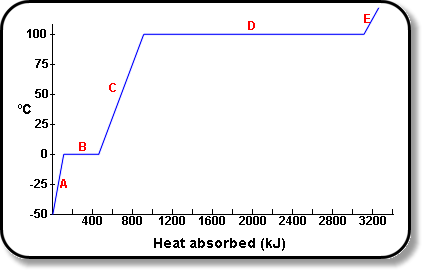
The diagram on the left shows the uptake of heat by 1 kg of water, as it passes from ice at -50 ºC to steam at temperatures above 100 ºC, affects the temperature of the sample.
E: Steam absorbs heat and thus increases its temperature.
D: Water boils and absorbs latent heat of vaporization.
C: Rise in temperature as liquid water absorbs heat.
B: Absorption of latent heat of fusion.
A: Rise in temperature as ice absorbs heat.
from-http://www.physchem.co.za/Heat/Latent.htm
Note- Heat of Vaporization questions occur in section D only and there is no temperature change. It stays at 100 Celsius.