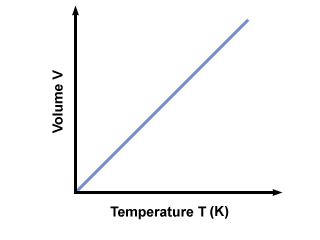
Charles’s law states that if a given quantity of gas is held at a constant pressure, its volume is directly proportional to the absolute temperature. Think of it this way. As the temperature of the gas increases, the gas molecules will begin to move around more quickly and hit the walls of their container with more force—thus the volume will increase. Keep in mind that you must use only the Kelvin temperature scale when working with temperature in all gas law formulas!
Change in Volume When Temperature Increases
Change in Volume When the Temperature Decreases (Watch the barrel first)
NOTE** Charles Law problems must have the PRESSURE CONSTANT. Try using Charles’s law to solve the following problem.
Example
A sample of gas at 15ºC and 1 atm has a volume of 2.50 L. What volume will this gas occupy at 30ºC and 1 atm?
OK, Here is our formula, . So, just plug in the numbers.
NO
As a Chemistry teacher I am REQUIRED to give you the temperature in Celsius and make you convert to Kelvin. It is the Law of all Chemistry Teachers.
So convert the temperatures to Kelvin. T1= 15C +273=288K and T2 =30C +273=303K
Now Plug in and Solve
2.50 L
=
V2
V2 = 2.63 L
288K
303K
This makes sense—the temperature is increasing slightly, so the volume should increase slightly. Again be careful of questions like this. It’s tempting to just use the Celsius temperature, but you must first convert to Kelvin temperature (by adding 273) to get the correct relationships!
Why must the temperature be absolute?
If temperature is measured on a Celsius (non absolute) scale, T can be negative. If we plug negative values of T into the equation, we get back negative volumes, which cannot exist. In order to ensure that only values of V= 0 occur, we have to use an absolute temperature scale where T= 0. The standard absolute scale is the Kelvin (K) scale. The temperature in Kelvin can be calculated via Tk = TC + 273.15. A plot of the temperature in Kelvin. Charles' law predicts that volume will be zero at 0 K. 0 K is the absolutely lowest temperature possible, and is called absolute zero.
from-www.sparknotes.com/.../ ideal/section2.rhtml
Highlight to reveal Answers
1. Calculate the decrease in temperature when 2.00L at 20.0oC is cooled to 1.00L.
V1=2.00L
V1
=
V2
T1=20.0oC + 273=293K
T1
T2
V2=1.00L
2.00L
=
1.00L
T2=?
293K
T2
( 2.00L)(T2) =(1.00L)(293K)
T2= 146.5K
DT=146.5K-273K=-146.5K
2. 600.0mL of air is at 20.0oC. What is the volume at 60.0oC?
V1=600.0mL
V1
=
V2
T1=20.0oC + 273=293K
T1
T2
V2=?
600.0mL
=
V2
T2=60.0oC +273= 333K
293K
333K
( 600.0mL)(333K ) =(V2)(298K)
V2= 681.9.mL
AP Try These-Highlight to reveal Answers
1. A ballon filled to a volume 7.00 x 10²mL at a temperature of of 20.0oC. The ballon then is cooledat constant pressure to a temperature of 1.00 x 10²K. What is the final volume of this balloon?
V1=7.00 x 10²mL
V1
=
V2
T1=20.0oC+ 273=293K
T1
T2
V2=?
7.00 x 10²mL
=
V2
T2=1.00 x 10²K
293K
1.00 x 10²K
(1.00 x 10²K)(7.00 x 10²mL)=(V2)(293K)
239mL = V2
2. A sample of gas at 15oC and 1.0 atm has a volume of 2.58L. What volume will this gas occupy at 38oC and 1 atm?



 . So, just plug in the numbers.