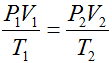
Questions | | Highlight to reveal the answers below |
| 1. A gas has a volume of 800.0 mL at minus 23.00 °C and 300.0 torr. What would the volume of the gas be at 227.0 °C and 600.0 torr of pressure? | | 1. V = [ (300 torr) (800 mL) (500 K) ] / [ (250 K) (600 torr) ]; x = 800.0 mL Keep in mind that torr = mmHg. |
| 2. 500.0 liters of a gas are prepared at 700.0 mm Hg and 200.0 °C. The gas is placed into a tank under high pressure. When the tank cools to 20.0 °C, the pressure of the gas is 30.0 atm. What is the volume of the gas? | | 2. V = [ (700/760) (500) (293) ] / [ (473) (30) ]; x = 9.51 L Note that this problem mixes pressure units. The 700/760 fraction converts mmHg to atm. |
| 3. What is the final volume of a 400.0 mL gas sample that is subjected to a temperature change from 22.0 °C to 30.0 °C and a pressure change from 760.0 mm Hg to 360.0 mm Hg? | | 3. V = [ (760 mm Hg) (400 mL) (303 K) ] / [ (295 K) (360 mm Hg) ]; x = 867.3 mL |
| 4. What is the volume of gas at 2.00 atm and 200.0 K if its original volume was 300.0 L at 0.250 atm and 400.0 K? | | 4. V = [ (0.25) (300) (200) ] / [ (400) (2) ] |
| 5. At conditions of 785.0 torr of pressure and 15.0 °C temperature, a gas occupies a volume of 45.5 mL. What will be the volume of the same gas at 745.0 torr and 30.0 °C? | | 5. V = [ (785) (45.5) (303) ] / [ (288) (745) ] |
| 6. A gas occupies a volume of 34.2 mL at a temperature of 15.0 °C and a pressure of 800.0 torr. What will be the volume of this gas at standard conditions? | | 6. V = [ (800) (34.2) (273) ] / [ (288) (760) ] |
| 7. The volume of a gas originally at standard temperature and pressure was recorded as 488.8 mL. What volume would the same gas occupy when subjected to a pressure of 100.0 atm and temperature of minus 245.0 °C? | | 7. V = [ (1) (488.8) (28) ] / [ (273) (100) ] |
| 8. At a pressure of 780.0 mm Hg and 24.2 °C, a certain gas has a volume of 350.0 mL. What will be the volume of this gas at STP? | | 8. V = [ (780) (350) (273) ] / [ (297.2) (760) ] |
| 9. A gas sample occupies 3.25 liters at 24.5 °C and 1825 mm Hg. Determine the temperature at which the gas will occupy 4250 mL at 1.50 atm. | | 9. T = [ (1.50 atm) (4.25 L) (297.5 K) ] / [(1825 mm Hg/760 atm mmHg) (3.25 L) ] Note that I cross multiplied. |
| 10. If 10.0 liters of oxygen at STP are heated to 512 °C, what will be the new volume of gas if the pressure is also increased to 1520.0 mm of mercury? | | 10. V = [ (760) (10) (785) ] / [ (273) (1520) ] |
| 11. What is the volume at STP of 720.0 mL of a gas collected at 20.0 °C and 3.00 atm pressure? | | 11. P = [ (3.00 atm) (720.0 mL) (273 K) ] / [ (293 K) (1.00 atm) |
| 12. 2.00 liters of hydrogen, originally at 25.0 °C and 750.0 mm of mercury, are heated until a volume of 20.0 liters and a pressure of 3.50 atmospheres is reached. What is the new temperature? | | 12. T = [ (3.50) (20) (298) ] / [ (750/760) (2.00) ] |
| 13. A gas balloon has a volume of 106.0 liters when the temperature is 45.0 °C and the pressure is 740.0 mm of mercury. What will its volume be at 20.0 °C and 780 .0 mm of mercury pressure? | | 13. V = [ (740 mmHg) (106 L) (293 K) ] / [ (318 K) (780 mmHg) ] |
| 14. If the absolute temperature of a given quantity of gas is doubled and the pressure tripled, what happens to the volume of the gas? | | 14. V = [ (1) (10) (2) ] / [ (1) (3) ] |
| 15. 73.0 mL of nitrogen at STP is heated to 80.0 °C and the volume increase to 4.53 L. What is the new pressure? | | 15. P = [ (1.00 atm) (73.0 mL) (353 K) ] / [ (273 K) (4530 mL) ] |
| 16. 500.0 mL of a gas was collected at 20.0 °C and 720.0 mm Hg. What is its volume at STP? | | 16. V = [ (720) (500) (273) ] / [ (293) (760) ] |
| 17. A sample of gas occupies 50.0 L at 15.0 °C and 640.0 mm Hg pressure. What is the volume at STP? | | 17.V = [ (640) (50) (273) ] / [ (288) (760) ] |