The Equilibrium Constant and the 

Mass Action Expression


-->FLASH The Meaning of the Equilibrium Constant<--


At equilibrium the following mathematical relationship exists. Substances that are excluded from this equation are SOLIDS AND LIQUIDS. They CANNOT change concentrations (they are pure), so they can not be included in this equilibrium expression.

Example of equilibrium constants

Reaction (all substances in the gas phase) Equilibrium Expression
3 O2 <===> 2 O3
N2 + 3 H2 <===> 2 NH3
H2 + I2 <===> 2 HI
PCl5 <===> PCl3 + Cl2
SO2 + (1/2) O2 <===> SO3


Why don't we include solids or liquids?

ANIMATION-Notice the change when more solid is added to the system. Hint there is none.


What do  equilibrium constants with solids look like?

The equilibrium produced on heating carbon with steam

Everything is exactly the same as before in the equilibrium constant expression, except that you leave out the solid carbon.


The equilibrium produced between copper and silver ions

Both the copper on the left-hand side and the silver on the right are solids. Both are left out of the equilibrium constant expression.


The equilibrium produced on heating calcium carbonate

This equilibrium is only established if the calcium carbonate is heated in a closed system, preventing the carbon dioxide from escaping.

The only thing in this equilibrium which isn't a solid is the carbon dioxide. That is all that is left in the equilibrium constant expression.


How do we calculate K when given concentrations?

Calculate the equilibrium constant (Keq) for the following reaction:

H2 + I2 <==> 2 HI 

[H2] = 0.0505 M
[I2] = 0.0498 M
[HI] = 0.389 M

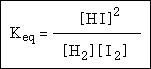
The first thing to do is write the equilibrium expression for the reaction as written in the problem. This is what to write:

Now, all you have to do is substitute numbers into the problem. Keq is what we want to find, so that's our "x."

Here is what we get:


Keq  (0.389)2

_______________

(0.0505) (0.0498)

Keq= 60.2

Solving this and rounding to the correct number of sig figs (remember those??), we get 60.2


Given Moles and Liters


What is the equilibrium constant for the gaseous reaction

2 N2 + O2 <--> 2 N2O

if, at equilibrium, 0.00335 mole N2, 0.000464 mol O2 and 0.545 mol N2O are in a 1.00-L container.

Solution:

The mass action expression for this reaction is

KC

 = 

[N2O]2


[N2]2[O2]

Using the given values in the equation,

KC

 = 

(0.545)2


(0.00335)2(0.000464)

KC

 = 

0.297025


(5.20724) x 10–9

KC = 5.7 x 10⁷


What does K imply?

Large K > 1 products are "favored"

K = 1 neither reactants nor products are favored

Small K < 1 reactants are "favored"

Practice Problems-Highlight to reveal answer

ANSWERS
2SO2(g) + O2(g) <-----> 2SO3(g) K = [SO3]2 /[SO2]2 [O2]
SO2(g) + 1/2O2(g) <-----> SO3(g) K= [SO3] / [SO2] [O2]1/2
4NH3(g) + 5O2(g) <-----> 4NO(g) + 6H2O(g) K= [NO]4 [H2O]6 / [NH3]4 [O2]5
Pb(NO3)2(s) <-----> PbO(g) + 2NO2(g) + 1/2O2(g) K = [PbO] [NO2]2 [O2]1/2


Kent Calculator you can move it


Calculations

At a certain temperature, the equilibrium mixture of PCl5 , PCl3 , and Cl2 has the following concentrations: