KentChemistry HOME


Custom Search

Predicting Double Replacement Reactions  

back to Kinetics and Equilibrium links

-->More Flash Animations<--


Step by step-

1. Write names of products by switching last names

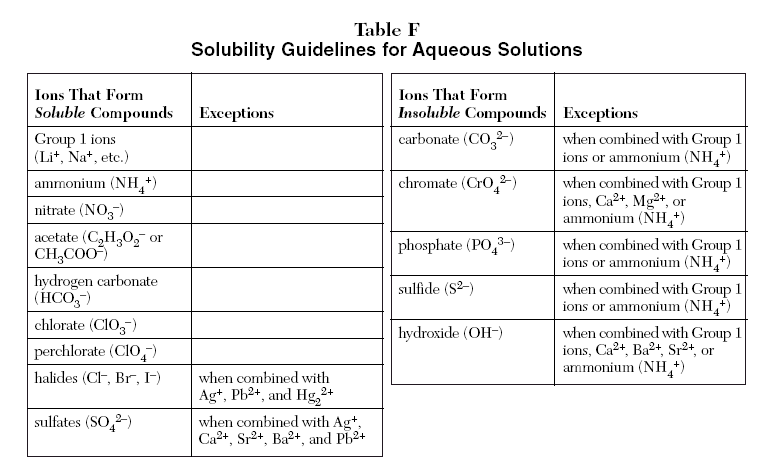
2. Check solubility on table F.

       soluble --> (aq)

        insoluble--> (s)= precipitate = means a reaction occurs

      2 soluble products = no reaction=STOP

3. Write the formulas for everything, with phases

        -write formulas based on charges

        -balance formulas

4. Balance overall reaction

***reactions also occur if  a gas is generated, water or a weak electrolyte (covered later) is produced


Alternative Method-

Predict reaction products given reactants Na2SO4 (Sodium Sulfate) and AlCl3 (Aluminum Chloride):

  1. Identify reactant ions
    2 Na+ + SO42- and Al3+ + 3 Cl-
  2. Interchange the ions
    Na+ + Cl- and Al3+ + SO42-
  3. Write correct formulas for the products (i.e., form the ions into compounds):
    NaCl from Na+ + Cl-
    Al2(SO4)3 from Al3+ + SO42-
  4. Write the complete molecular equation for the reaction
    Na2SO4 + AlCl3 --> NaCl + Al2(SO4)3
  5. In order to write a complete ionic equation for the reaction, write all soluble reactants and products as separated ions, for that is how they exist in solution:
    Na+ + SO42- + Al3+ + Cl- --> Na+ + Cl- + Al2(SO4)3
    Note: in general, all of the reactants are soluble but not all of the products if an overall reaction occurred
    Note: Don't worry about balancing the equation, but get the formulas of the species involved right.
  6. In order to write a net ionic equation, remove the spectator ions from the complete ionic equation. The spectator ions are the free ions that are unchanged in the reaction, so they appear on both sides of the complete ionic equation.
    SO42- + Al3+ --> Al2(SO4)3
    Note: the net ionic equation involves only the product of the reaction that is the driving force of the reaction, and the reactant ions that lead directly to that product.


LINK-->Flash Quiz Solubility of Ionic Compounds<--LINK

Important note on Specific Product that decompose into gases

Incorrect               Correct

H2CO3 (aq)     -->      H2O(l) + CO2 (g)

H2SO3  (aq)      -->      H2O(l) + SO2 (g)

NH4OH (aq)    -->      NH3 (g) + H2O (l)                      

                       and    H2S

examples

CaCO3(aq)  + HCl (aq) ---> CaCl2 (aq) + CO2(g) + H2O (l)
K2SO3 (aq) + HNO3(aq)  ---> KNO3 (aq) + SO2(g) + H2O (l)
NH4Cl (aq) + NaOH(aq)  ---> NaCl (aq) + NH3(g) + H2O (l)

Link-->DR Gas Product-->Flash

Examples

AgClO3(aq)    +    Ni(NO3)2(aq) ® NO REACTION
BaCl2(aq)    +    Na2CO3(aq) ® BaCO3(s)      +  2NaCl(aq)
Al2(SO4)3(aq)    +    2Na3PO4(aq) ® 2AlPO4(s)      +  3Na2SO4(aq)
3BaCl2(aq)    +    2H3PO4(aq) ® Ba3(PO4)2(s)      +   6HCl(aq)
K2SO4(aq)    +    MgF2(aq) ® NO REACTION
Na2CO3(s)    +    CaCl2(aq) ® CaCO3(s)      +   2NaCl(aq)
AlCl3(aq)    +    BaSO4(aq) ® NO REACTION
Na2SO4(aq)    +    NH4ClO3(aq) ® NO REACTION
Mg3(PO4)2(s)    +    3BaCl2(aq) ® Ba3(PO4)2(s)   +   3MgCl2(aq)
AlBr3(aq)    +    H3PO4(aq) ® AlPO4(s)   +    3HBr(aq)  
Zn(NO3)2(aq)    +    Ba(OH)2(aq) ® Zn(OH)2(s)    +   Ba(NO3)2(s)  


1) 3Ca(OH)2(aq) + 2H3PO4(aq) ---> Ca3(PO4)2(s)  + 6H2O(l)

2) K2CO3(aq)  + BaCl2(aq)  ---> 2KCl(aq)  + BaCO3(s)

3) 2Na3PO4(aq)  + (NH4)2S(aq)  ---> 3Na2S(s) + 2(NH4)3PO4(aq)

4) H3PO4(s)  + FeBr3(aq)  ---> FePO4(aq)  + 3HBr(l)

5) AgNO3(aq)  + KCl (aq) ---> AgCl(s) + KNO3(aq)

6) Na2CO3(aq)  + H2SO4 (aq) ---> Na2SO4 (aq) + CO2(g) + H2O(l)

7) H2SO4 (aq) + BaCl2 (aq) ---> BaSO4(s)  + 2HCl(aq)

8) Al2(SO3)3(aq)  + 2H3PO4(aq)  ---> 2AlPO4(s) + 3H2O(l) +3SO2(g)

9) Na2CO3(aq)  + 2HCl(aq)  ---> 2NaCl(aq) + CO2(g)  + 2H2O(l)

10) 2AgC2H3O2(aq)  + K2CrO4(aq)  ---> Ag2CrO4(s) + 2KC2H3O2(aq)


back to Kinetics and Equilibrium links

Chemical Demonstration Videos