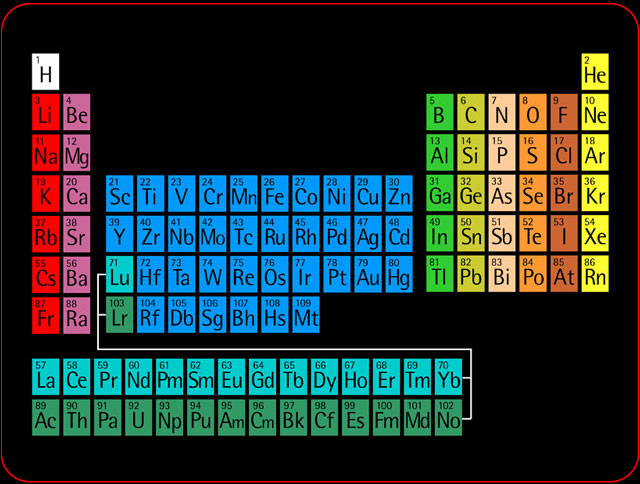
No chemistry textbook, classroom, lecture theatre or research laboratory is complete without a copy of the periodic table of the elements. Since the earliest days of chemistry, attempts have been made to arrange the known elements in ways that revealed similarities between them. However, it required the genius of Mendeleev to see that arranging elements into patterns was not enough; he realized that there was a natural plan in which each element has its allotted place, and this applies not only to the known elements but to some that were still undiscovered. Today we have the so-called long form of the table. This has emerged supreme from well over 100 designs that have been proposed since the time of Mendeleev. With the advantage of hindsight we can now see why this form of the table was bound to succeed.
Today there are 111 elements recognized by IUPAC, and these are usually displayed in the form of a matrix called a periodic table. The term periodic came from the regular occurrence of certain chemical properties in the list of known elements when these are arranged in order of increasing relative mass. The common form, complete with the new group numbers (1-18) were finally agreed by the International Union of Pure Applied Chemistry, IUPAC, in 1985, after years of wrangling. In truly Parkinsonian fashion, this least important of changes has probably consumed the most effort!
Since Antoine Lavoisier first defined a chemical element and drew up a table of 33 of them for his book 'Traité Elémentaire de Chimie' (Treatise on the Chemical Elements) published in 1789, there have been attempts to classify them. Lavoisier himself grouped them into four categories on the basis of their chemical properties: gases, nonmetals, metals and earths. In the first category he listed substances that we now know as oxides but which at the time had defeated all attempts at separation.
This desire to identify and classify elements continued in chemistry for another 80 years until Mendeleev stumbled upon the correct classification - the periodic table. Today the periodic table is securely based on the properties of atomic number of the nucleus and the electron energy levels which surround it. Both of these concepts postdate Mendeleev by several decades. He, however perceived them indirectly through the related properties of atomic weight and chemical valency and arrived at the periodic table in 1869.
Because atomic weight, relative atomic mass, is roughly proportional to atomic number, and because valency, which manifests itself in the chemical composition, is based on the outermost electrons of an atom, Mendeleev had chosen the two properties that in his day most nearly reflected the fundamental principles on which the table today is based. Consciously or subconsciously, he arrived at the idea that a table existed with positions that were to be occupied by the elements, rather than the other way round - that the known elements determined the arrangement of the table, as others imagined.
This being so, Mendeleev then put the 65 elements he knew into his table and at the same time pointed out the many unoccupied positions in the overall scheme. He took the further and much bolder step of predicting the properties of these missing elements. Moreover, the gap in atomic weights between cerium (140) and tantalum (182) suggested to him that a whole period of the table remained to be discovered. Later in the century many of these elements, which we now call the lanthanides, were isolated.
Historical Background
Mendeleev’s periodic table of 1869 seems all the more remarkable when we consider his relative isolation from the main centers of chemical research in Western Europe, and the rather naive attempts made by scientists in those centers to bring some sort of order to the growing list of chemical elements.
As early as 1829 Johann Döbereiner announced his law of Triads, which referred to groups of three chemically similar elements in which the properties of the middle element could be inferred from the lighter and heavier ones. Such triads as lithium, sodium and potassium, sulfur, selenium and tellurium or chlorine, bromine and iodine are clear examples. By 1843 when Leopold Gmelin published the first edition of his famous Handbuch der Chemie , three tetrads and even a pentad - nitrogen, phosphorus, arsenic, antimony and bismuth - which we now recognize as group 15 of the p-block of the periodic table.
No real progress was going to be made in classifying elements until the one essential property common to them all, their atomic weight, was settled. This was done by Stanislao Cannizzaro in 1858. Prior to this, equivalent weights were used and for many elements there were several equivalent weights, depending upon the elements oxidation state.
Telluric Screw and Law of Octaves
Béguyer de Chancourtois in 1862 was the first person to make use of atomic weights to reveal periodicity. He drew the elements as a continuous spiral around a cylinder divided into 16 parts. The atomic weight of oxygen was taken as 16 and used as the standard against which all others were compared. Chancourtois noticed that certain of the triads appeared below one another in his spiral. In particular the tetrad oxygen, sulfur, selenium and tellurium fell together, and he called his device the “telluric screw”.
The atomic weights of these elements are 16,32,79 and 128, respectively, and quite fortuitously they are multiples or near multiples, of 16. Other parts of the screw were less successful. Thus boron and aluminum come together all right but are then followed by nickel, arsenic, lanthanum and palladium. Chancourtois had discovered periodicity, but had got the frequency wrong. Not bad for a non - chemist - he was a geologist.
Another man who got nearer was John Newlands, Professor of Chemistry at the School of Medicine for Women, London. He chose a table of seven columns and entered his elements in increasing order of atomic weight. This arrangement produced some misalignments, but Newlands was sufficiently secure in his chemical knowledge to put similar elements in the same column even if it meant squashing two elements into some of his boxes. Newlands also recognised silicon and tin as part of a triad and predicted that there would be a missing element intermediate between these, with atomic weight of about 73. This predated Mendeleev’s predictions about germanium (which has an atomic weight of about 72.6) by about five years. However, Newlands did not leave a space for this missing element in his table of 1865. In fact, he left no vacant slots, which reveals that he had no appreciation of looking for an order that transcended his data.
By analogy with the tonic scale of seven musical notes and their octaves, Newlands called his discovery of periodicity the ‘Law of Octaves’. His efforts were criticised, indeed were publicly ridiculed, by members of the chemical fraternity and it was only in 1887, 18 years after Mendeleev’s work that Newlands’s contribution was recognised by the Royal Society, which awarded him the Davy medal.
Other Attempts
Other chemists who were sufficiently intrigued by atomic weights and the periodic occurrence of chemical properties also proposed repeating units of 1 (William Odling, 1864) and 15 (Lothar Meyer, 1868). The first of these, Odling, drew up a table of elements that bears a striking resemblance to Mendeleev’s first table. The groups are horizontal, the elements are in order of increasing atomic weight and there are vacant slots for undiscovered ones. In addition, Odling overcame the tellurium iodine problem, and he even managed to get thallium, lead mercury and platinum in the right groups - something that Mendeleev failed to do at his first attempt. However, we need lose little sleep over Odling’s failure to achieve recognition, since it is suspected that he, as Secretary of the London Chemical Society, was instrumental in discrediting Newlands’s efforts at getting his periodic table published.
The German chemist Julius Lothar Meyer also used Cannizzaro’s atomic weights to draw up a primitive table in 1864, but the more sophisticated version he produced in 1868 for the second edition of his textbook was not used and remained among his papers to be published only after his death in 1895. However, what Meyer did was to publish in 1870 a graph which plotted atomic volumes against atomic weights. This clearly showed the periodic changes of this property, with maximum atomic volumes at intervals of 7, 7, 14 and 15. With the inclusion of undiscovered elements this graph would have revealed the observed intervals of 8, 8, 18 and 18 of the first four rows of the modern table.
Meyer published too late to claim priority over Mendeleev but just in time to confirm that the latter’s discovery of the periodic table was based on sound chemical principles. Although Mendeleev published his tables in the new and obscure journal of the Russian Chemical Society, his paper was abstracted within weeks of its appearance into the German journal Zeitschrift für Chemie, and well before Meyer’s paper was published in December of that year, 1869.
Mendeleev’s Genius
What then did Dimitri Ivanovich Mendeleev do that sets his table apart from those earlier tables? The height of his achievement can partly be judged by the depths from which he started. Born in Tobolsk in Western Siberia in 1834, the youngest of 14 children, whose father became blind and died of tuberculosis the year Dimitri finished school, Dimitri was his mother’s favorite and she did all she could to further his education. After graduating from the Central Pedagogic Institute of St Petersburg, Dimitri went on to do research in Paris and Heidelberg for two years, before returning in 1861 to St Petersburg, where he eventually became professor of general chemistry in 1867.
He began writing a textbook of inorganic chemistry, 'Principles of Chemistry', which eventually ran into many editions and translations. In organizing the material for this work, he grouped elements into chapters according to their valency. While in Germany, Mendeleev had learned of Cannizzaro’s atomic weights, and he used these to arrange the elements in ascending order.
The fateful day for Mendeleev was 17 February 1869 (Julian calendar). He cancelled a planned visit to a factory and stayed at home working on the problem of how to arrange the chemical elements in a systematic way. To aid him in this endeavor he wrote each element and its chief properties on a separate card and began to lay these out in various patterns. Eventually he achieved a layout that suited him and copied it down on paper. Later that same day he decided a better arrangement was possible and made a copy of that, which had similar elements grouped in vertical columns, unlike his first table, which grouped them horizontally. These historic documents still exist.
That Mendeleev realized that he had discovered, rather than designed, the periodic table is shown by his attitude towards it. First, he left gaps in it for missing elements. Leaving such gaps in tables of elements was not in itself new, but Mendeleev was so sure of himself that he was prepared to predict the physical and chemical properties of these undiscovered elements. His most notable successes were with eka aluminum (= Gallium) and eka-silicon (= germanium). Lecoq de Boisbaudran discovered gallium in 1875 and reported its density as 4.7g cm -3, which did not agree with Mendeleev’s prediction of 5.9g cm -3. When he was told that his new element was Mendeleev’s eka-aluminum, and had most of its properties foretold accurately, Boisbaudran redetermined its density more accurately and found it to be as predicted, 5.956 g cm -3. There could be no doubt now that Mendeleev had discovered a fundamental pattern of Nature.
Secondly, Mendeleev was prepared to place elements in his table in apparently the wrong group. Thus the oxide of beryllium had been reported to be Be2O3 by none other than the great chemist Berzelius. Later workers claimed it to be BeO. The former gave the element a valency of III, the latter II. Mendeleev had a vacancy in his table for an element in group II, and so he had no hesitation in placing beryllium in it.
Thirdly, Mendeleev was prepared to place elements in his table in the wrong order of atomic weight. The anomaly here was that tellurium (atomic weight 128) should come after iodine (127), whereas the group for Te is clearly the one before I. Mendeleev presumed that the atomic weight of Te had been determined wrongly. However, fresh analyses confirmed the original value and this anomaly remained as a puzzle for chemists until the discovery of isotopes. Where I has only a single isotope of mass number 127, Te has eight stable isotopes of mass numbers 120 to 130, and the most abundant is 130Te (32%). This results in the high average atomic weight of 128.
Difficulties and Errors
Mendeleev knew of only this one exception to the atomic weight arrangement, but today we know there are four other pairs in which the element with the higher atomic number has the lower atomic weight. These are argon-potassium (argon was not discovered until 1894), cobalt-nickel (the difference is only 0.24 atomic mass units, which was within the limits of experimental error in Mendeleev’s time), thorium protactinium (the latter was made in 1940). Had he known of several of these isotope anomalies Mendeleev might have been deterred from using atomic weights as his first principle.
In his classic paper published in the new Russian Journal of General Chemistry (Zh. Russ. Khim. Obshch.) Mendeleev published both forms of the periodic table. The best-known version of his table, however, is the one he published in 1871.
Closer inspection of Mendeleev's periodic table of 1869 (vertical form), which is generally reproduced as the original periodic table, reveals some of the difficulties he had in putting the elements into groups. He spotted that the titanium group needed a final heavy metal member, and predicted that it would be found among titanium ores. This missing element was discovered by the Hungarian chemist George de Hevesy in 1923. It's atomic weight of 178 is very close to that of 180 predicted by Mendeleev. The element is now called hafnium, and is found in what is now called group 4.
The manganese group Mendeleev got entirely wrong, but this is not surprising since the multiple oxidation states displayed by elements at the centre of the d block were of little help in assigning elements to groups. Moreover, the element below manganese is technetium, which has no stable isotopes long-lived enough to have survived since the formation of the Earth. This element was first isolated by Emilio Segrè in 1939 from a sample of molybdenum that had been bombarded by deuterons.
Mendeleev also imagined mercury, with its two common oxidation states of I and II, to be in the same group as copper and silver, even though this meant its coming before gold which has a lower atomic weight in the table. Consequently, Mendeleev felt he had to query the atomic weight of gold, which he put in the boron group under uranium. This last element was wrongly placed because its atomic weight was erroneously thought to be 116, half of what it should be.
Similarly, Mendeleev struggled unsuccessfully to accommodate those other f-block elements which were known at the time : erbium, yttrium, cerium, thorium and didymium. This last element was in fact a mixture of praseodymium and neodymium. Most of these had atomic weights that were wrong in any case, and that was true of indium, which had been discovered in 1863 by Ferdinand Reich and Hieronymus Richter. Had more of its chemistry and had the correct atomic weight been available, then Mendeleev would been able to displace uranium from the boron group and put indium there.
Despite all these errors in his table, and maybe even because of them, we can appreciate the struggle that Mendeleev had on that winter’s day in St Petersburg 116 years ago.
It has even been suggested that Mendeleev realized that there were gaps in the list of elements between H and Li, F and Na and Cl and K. These gaps in the table are now occupied by the noble gasses, discovered by Lord Rayleigh, William Ramsay and Morris Travers in the mid-1890s. Curiously, the first to be isolated, argon, is the one whose atomic weight is out of line, so its position in the table is not immediately obvious. Even before argon was discovered by Ramsey he had written to Rayleigh speculating that there should be three gaseous elements that would fit into the periodic table above the three elements of group VIII, iron, cobalt and nickel.
The discovery of argon followed soon after, but its position was clearly not next to fluorine but in the row beneath. However, Ramsay was able to deduce that there must be another inert monatomic gas above argon, and he calculated its atomic weight at about 20. This was isolated by the group in 1898 as neon, mass = 20.18.
The Periodic Table since Mendeleev
More than 700 versions of the periodic table were produced in the century after Mendeleev’s table, and these have been analysed by Edward Mazurs in his 'Graphic Representations of the Periodic System During 100 Years', Mazurs was concerned with the format of these tables and devised an elaborate classification of them which enabled him to give each a code as follows:
(b.) Three dimensional tables with curved or helical arrangements = A; two-dimensional curves and spirals = B; two-dimensional matrix layout = C
Within these main groups further divisions depended upon the relative positions of groups and other properties. Thus Mendeleev ‘s table (Ramsay’s prediction of undiscovered gaseous elements in 1894) is categorized as IC2-1 and the modern long form of the table (the modern periodic table) is IIIC3-4.
A simpler and neater subdivision, and one that serves to explain why the latter is the preferred form is as follows:
(a.) Continuous versus discontinuous listing of the elements (b.) The number of groups in the table : 8,18 or 32 (c.) Two or three-dimensional representation
Continuous tables
Since the elements are to be ranked in sequence according to atomic number 1 to 109, the natural way of presenting these is as a continuous tape that can then be looped as a helix or spiral so as to bring together elements of similar electronic configuration that share common properties. Although three-dimensional arrangements are possible and can be represented on paper, they have not been popular, and this may also explain why Chancourtois’s table did not receive the recognition it deserved.
Quite exotic loops and curls can be produced, such as that designed by Romanoff in 1934, but three-dimensional periodic tables are of little practical use. Two-dimensional continuous tables first appeared only a year after Mendeleev ‘s, when H Baumhauer designed a spiral table beginning with hydrogen in the centre, and this format is still to be seen in ‘ornamental’ tables because of its visual appeal. The Festival of Britain version of 1951 unfortunately crowds together the more common elements at the centre while giving the less important f-block elements a disproportionate amount of space at the periphery. Sometimes this circular format is imposed on the table by virtue of the medium itself, as on the medal issued to commemorate the Centenary of Mendeleev ‘s table in 1969.
Discontinuous tables
Attractive as the continuous tables are, the discontinuous tables have been undoubtedly more numerous and popular. Discontinuities have been introduced in various ways, and some of these tables appear at first glance to be almost of the continuous kind, such as the one drawn by Sheele in 1950. The analogy with electron orbits around a central nucleus is an added attraction of this table, but closer inspection shows that certain elements do not follow in atomic-number sequence - nor can they in a table which is arranged in order of the principal quantum number.
Discontinuous tables are almost invariably of a linear format and with atomic numbers increasing from left to right and down the table. All these features are so taken for granted as no longer to be questioned, but we should not forget that Mendeleev ‘s first table, though discontinuous, has the elements arranged in horizontal groups with atomic weights increasing from top to bottom. However, his original paper also contained a table with the groups arranged in vertical groups, as in the common type used today.
The reason why this particular format has triumphed is probably due to the Western way of reading in which we can scan from left to right and top to bottom. This familiar eye movement obviously will encourage a table designed to conform to it. We need look no further to explain why the standard periodic table has always been of this form, whether it has been of the 8-, 18- or 32- group format.
With discontinuous tables there need to be defined discontinuities, and early tables had no special reason for ending a row with any particular group. The earliest 8-group tables in which elements were grouped according to ‘valency’ naturally started at valency I and ended at valency VIII. Such tables however, brought together elements sharing a common valency but little else. Thus it became necessary to have subgroups A and B in order to make chemical sense of the groups. This A and B terminology was eventually to lead to a conflict between periodic tables that was only finally resolved in 1985 by the intervention of the International Union of Pure and Applied Chemistry.
With the discovery of the so-called noble gases, the obvious place for them was in a group O on the left hand side of the table because these elements were considered to be chemically inert until Bartlett’s discovery of the first xenon compound in 1962. However, the noble gasses were soon to occupy a special place in the theory of chemical bonding, their inertness, and this idea of filling electron shells as one moves along a row on the right and marked the end of a particular row.
The long form of the periodic table with the modern format has been attributed to H G Deming, who devised it for his textbook in 1923. Its popularity was ensured when it was adopted by a drug company as part of their promotional material. This gave it wide publicity, but clearly it met a need, and it gradually ousted all others until today it reigns supreme. However, it has a longer ancestry than this; 18-group tables can be traced back to the 19th century - even Mendeleev came up with a version, in his case based on 17 groups, of course.
The modern table is not content solely to list the elements in rows ending with the noble gasses, but fragments the table into five blocks accordingly to the type of orbital shell which is being filled. The structure of the table is now taught in terms of the four quantum numbers n, l, m and s. The rows ending with a block are based on the principle quantum number n, with its integral values 1, 2, 3 and so on. The blocks are called after the orbital quantum number 1, which can have the numerical values 0,1,2 . . . n but which are generally given the alphabetical symbols s, p, d, f for = 0, 1, 2, 3, respectively. The other two quantum numbers establish the number of groups within a block.
Final Form
The periodic table of the chemical elements has thus reached its final form, firmly grounded on atomic theory, and it seems unlikely that any other version will now dislodge it from its dominant position. The only unresolved difficulty is the location of hydrogen and helium at the top of the table.
Strict adherence to electron orbital theory would mean placing these elements above lithium and beryllium at the head of the s-block. Unfortunately, they have little or nothing in common with these metals except a formal oxidation state of 1 in the case of hydrogen and lithium. Alternatively, these elements can be placed to the right of the table above fluorine and neon. And while hydrogen may sit uneasily above the halogen family, helium certainly sits comfortably as a member of the noble gases. Yet hydrogen is not without some properties in common with fluorine. Both are diatomic gases, both form a variety of single bonds to other elements, both can exist as anions. The issue has been resolved by placing hydrogen and helium in a separate 1 s-block of the periodic table on the right hand side. While helium will always be found in this location, hydrogen is such that it can justify being sited at either side, or even in the centre of the table. What information should a periodic table contain?
Each box of the table must contain the essential information of the atomic number, the element’s identity (name) and its agreed chemical symbol (formula). Beyond this, the information is arbitrary, although almost without exception the relative atomic mass, that is, the atomic weight, is included as this is probably the single most important piece of information sought from the table, and it has the merit of historical continuity.
The periodic table can act as a very useful framework for classifying information, and periodic tables with data of use to chemists, physicists, spectroscopists, metallurgists and others have been produced. Some tables have up to 20 pieces of numerical data in each box.
The periodic table is, and probably always will be, the trademark of inorganic chemistry. Its beauty, its simplicity and its coding of fundamental laws of nature are unsurpassed. It has even been turned into a card game!