Precipitation Reactions

LINK-->Regents Chemistry Review of this topic <--Link

 Dissociation- Ionic compounds dissolve in water and the ions separate and move independently

AgNO3(aq) + NaCl(aq) à products

Ag+ (aq) + NO3-(aq) + Na+(aq) + Cl- (aq)à products

Determination of Products  Recombination of ions

AgNO NaCl  AgCl  NaNO3

Elimination of reactants as products

AgNO3 and NaCl are reactants and can't be products

 Identifying the precipitate"Switch Partners" of reactant pairs to determine the names of the products.

AgCl and NaNO3 are the products

AgCl is insoluble, so it is the precipitate


 If there is no insoluble product, there is NO REACTION.

NaCl(aq) + KNO3(aq) à NaNO3(aq) + KCl(aq)

Both products are soluble and all ions remain independent in solution; no reaction occurs

Na+(aq) + Cl-(aq) + K+(aq) + NO3-(aq)

***Important note on Specific Product that decompose into gases

Incorrect               Correct

H2CO3 (aq)     -->      H2O(l) + CO2 (g)

H2SO3  (aq)      -->      H2O(l) + SO2 (g)

NH4OH (aq)    -->     H2O (l) + NH3 (g)

examples

CaCO3(aq)  + HCl (aq) ---> CaCl2 (aq) + CO2(g) + H2O (l)
K2SO3 (aq) + HNO3(aq)  ---> KNO3 (aq) + SO2(g) + H2O (l)
NH4Cl (aq) + NaOH(aq)  ---> NaCl (aq) + NH3(g) + H2O (l)


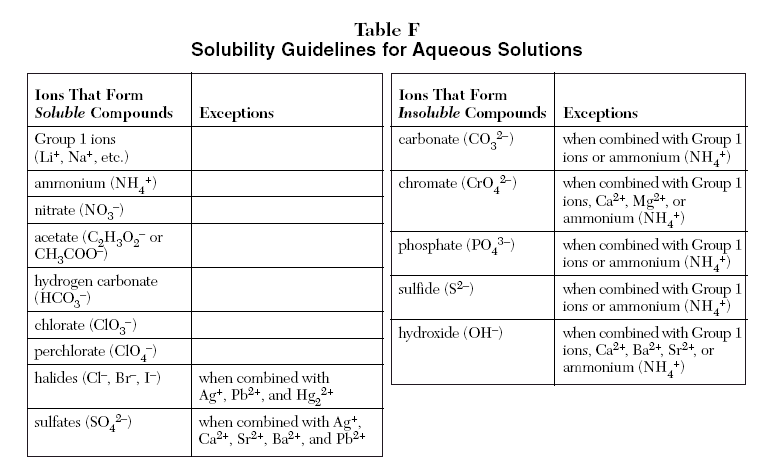
Solubility Rules

  • All common compounds of Group I and ammonium ions are soluble.
  • All nitrates, acetates, and chlorates are soluble.
  • All binary compounds of the halogens (other than F) with metals are soluble, except those of Ag+, Hg22+, and Pb2+. Pb2+ halides are soluble in hot water.)
  • All sulfates are soluble, except those of barium(Ba2+), strontium(Sr2+), calcium(Ca2+), lead(Pb2+), silver(Ag+), and mercury (I) (Hg22+). The latter three are slightly soluble.
  • Except for rule 1, carbonates (CO32-), hydroxides (OH-), oxides(O2-), silicates(SiO32-), and phosphates (PO43-) are insoluble.
  • Most Sulfides (S2-) are insoluble except for calcium (Ca2+), barium(Ba2+), strontium(Sr2+), magnesium(Mg2+), sodium(Na+), potassium(K+), and ammonium(NH4+).


Complete the reaction and balance (include phases)

AgClO3(aq)    +    Ni(NO3)2(aq) ® NO REACTION
BaCl2(aq)    +    Na2CO3(aq) ® BaCO3(s)      +  2NaCl(aq)
Al2(SO4)3(aq)    +    2Na3PO4(aq) ® 2AlPO4(s)      +  3Na2SO4(aq)
3BaCl2(aq)    +    2H3PO4(aq) ® Ba3(PO4)2(s)      +   6HCl(aq)
K2SO4(aq)    +    MgF2(aq) ® NO REACTION
MgCO3(aq)    +    CaCl2(aq) ® CaCO3(s)      +   MgCl2(aq)
AlCl3(aq)    +    BaSO4(aq) ® NO REACTION
Na2SO4(aq)    +    NH4ClO3(aq) ® NO REACTION
Mg3(PO4)2(aq)    +    3BaCl2(aq) ® Ba3(PO4)2(s)   +   3MgCl2(aq)
AlBr3(aq)    +    H3PO4(aq) ® AlPO4(s)   +    3HBr(aq)  
Zn(NO3)2(aq)    +    Ba(OH)2(aq) ® Zn(OH)2(s)    +   Ba(NO3)2(s)  

   Highlight to reveal answers

1) 3Ca(OH)2(aq) + 2H3PO4(aq) ---> Ca3(PO4)2(s)  + 6H2O(l)

2) K2CO3(aq)  + BaCl2(aq)  ---> 2KCl(aq)  + BaCO3(s)

3) Cd3(PO4)2(aq)  + 3(NH4)2S(aq)  ---> 3CdS(s) + 2(NH4)3PO4(aq)

4) Co(OH)3(aq)  + 3HNO3(aq)  ---> Co(NO3)3(aq)  + 3H2O(l)

5) AgNO3(aq)  + KCl (aq) ---> AgCl(s) + KNO3(aq)

6) Na2CO3(aq)  + H2SO4 (aq) ---> Na2SO4 (aq) + CO2(g) + H2O(l)

7) Al(OH)3(aq)  + 3HC2H3O2 (aq) ---> 3Al(C2H3O2)3(aq)  + 3H2O(l)

8) Al2(SO4)3(aq)  + Ca3(PO4)2(aq)  ---> 2AlPO4(s) + 3CaSO4(s)

9) Cr2(SO3)3(aq)  + 3H2SO4(aq)  ---> Cr2(SO4)3(aq) + 3SO2(g)  + 3H2O(l)

10) 2AgC2H3O2(aq)  + K2CrO4(aq)  ---> Ag2CrO4(s) + 2KC2H3O2(aq)


web stats analysis