Earnest Rutherford- From New Zealand, one of 12 children born on a farm. Rutherford was a scholarship research student under J.J. Thomson at Cavendish Lab at Cambridge University. Did thesis research on the properties of charged particles. Identified alpha particle as a Helium nucleus (protons and neutrons, no electrons) and beta particle as an electron.
After this he worked at McGill University in Montreal, Canada. He worked on the origin of alpha particles (from the disintegration of elements) and won the Noble Prize .
He became a Professor of Physics at Victoria University in Manchester, UK.
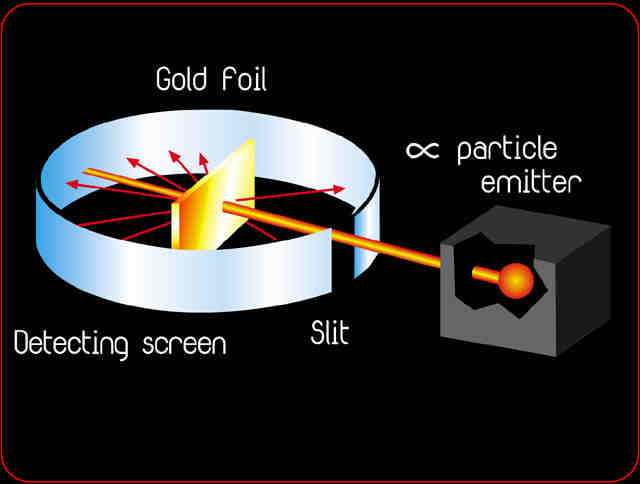
The experiment to probe the structure of the atom performed by Hans Geiger (Geiger counter) and Ernest Marsden in 1909, under the direction of Ernest Rutherford at the Physical Laboratories of the University of Manchester.
(Rutherford gets all the credit, while his graduate students did the work.)
The Experiment
A beam of alpha particles, generated by the radioactive decay of radium, was directed onto a sheet of very thin gold foil.
The gold foil was surrounded by a circular sheet of zinc sulfide (ZnS) which was used as a detector: The ZnS sheet would light up when hit with alpha particles.
The Results
Observation
Conclusion
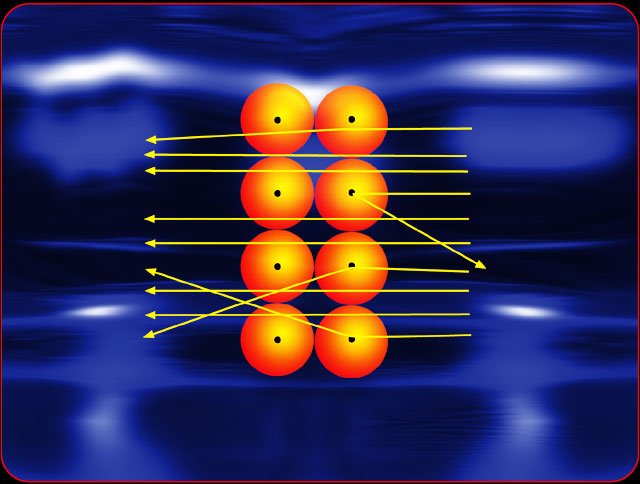
the vast majority of particles passed straight through the foil
Atoms are mostly made of open space
a very small percentage of particles were deflected through angles much larger than 90 degrees
massive center with a + charge (the nucleus)
"It was quite the most incredible event that has ever happened to me in my life. It was almost as incredible as if you fired a 15-inch shell at a piece of tissue paper and it came back and hit you. On consideration, I realized that this scattering backward must be the result of a single collision, and when I made calculations I saw that it was impossible to get anything of that order of magnitude unless you took a system in which the greater part of the mass of the atom was concentrated in a minute nucleus. It was then that I had the idea of an atom with a minute massive center, carrying a charge."
—Ernest Rutherford
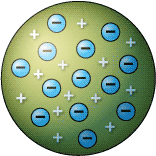
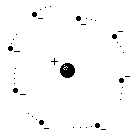
Adjustment to the Model of the Atom-Now with open space & positive nucleus
J.J. Thomson
Rutherford
Problems with the new model resulted in a strong negative reaction in the scientific community
1. Nuclear Collapse
Negative particles revolving around a positive nucleus should collapse ...."Collumbic attraction" between +ive and -ive particles.
2. Energy Deficit
Revolving electrons changes direction, which means there is acceleration. What powers the accelerating electron?
Adjustment to the Model of the Atom-Now with open space & positive nucleus