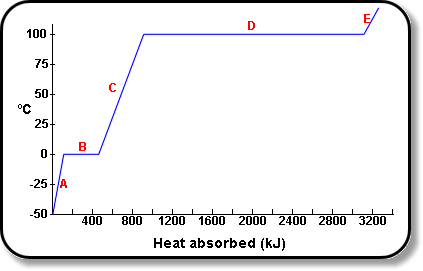
The diagram on the left shows the uptake of heat by 1 kg of water, as it passes from ice at -50 ºC to steam at temperatures above 100 ºC, affects the temperature of the sample.
A: Rise in temperature as ice absorbs heat. B: Absorption of heat of fusion. C: Rise in temperature as liquid water absorbs heat. D: Water boils and absorbs heat of vaporization. E: Steam absorbs heat and thus increases its temperature.
from-http://www.physchem.co.za/Heat/Latent.htm
***UNITS NOTE J g-1 ºC-1 = J / g ºC; any exponent to the -1 is placed in the denominator.
The specific heat capacity of water is 4.18 J g-1 ºC-1. The specific heat capacity for Ice and Steam are 2.09 J g-1 ºC-1.
The heat of fusion of ice is 334 J g-1, and the heat of vaporization of water is 2260 J g-1.
EXAMPLE Calculate the amount of heat required to completely convert 50 g of ice at -10 ºC to steam at 120 ºC.
Heat is taken up in five stages:
1. The heating of the ice
2. The melting of the ice,
3. The heating of the water,
4. The vaporization of the water and
5. The heating of the steam.
The heat taken up in the complete process is the sum of the heat taken up in each stage.
1.Heat taken up heating the ice from -10 ºC to the melting point, 0 ºC.
mass of water x specific heat x temperature change = 50g x 2.09 (J g-1 ºC-1)x 10 ºC = 1,045 J
2. Heat taken up for converting ice at ºC to water at ºC.
mass of water x latent heat of fusion = 50g x 334 (J g-1) = 16,700J
3. Heat taken up heating the water from 0 ºC to the boiling point, 100 ºC.
mass of water x specific heat x temperature change = 50g x 4.18 (J g-1 ºC-1)x 100 ºC = 20,900 J
4. Heat taken up vaporizing the water.
mass of water x heat of vaporization 50g x 2260 J g-1 = 113,000 J
5.Heat taken up heating the steam from 100 ºC to 120 ºC.
mass of water x specific heat x temperature change = 50g x 2.09 (J g-1 ºC-1)x 20 ºC = 2,090 J