 Custom Search
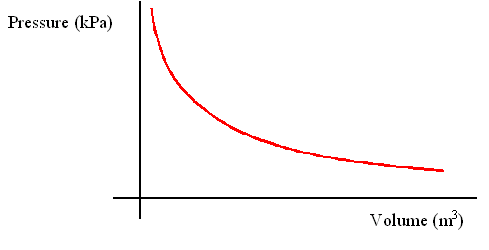
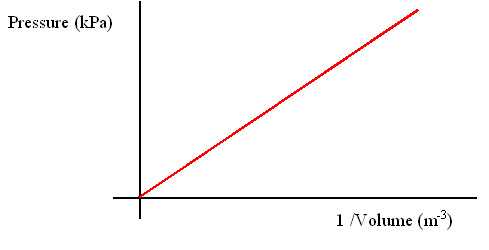
In 1662, Robert Boyle made the first systematic study of the relationship between volume and pressure in gases. Boyle’s law simply states that the volume of a confined gas at a fixed temperature is inversely proportional to the pressure exerted on the gas. This can also be expressed as PV = k P is inversely related to V. This makes sense if you think of a balloon. When the pressure around a balloon increases, the volume of the balloon decreases, and likewise, when you decrease the pressure around a balloon, its volume will increase. Boyle’s law to can also be expressed in the following way, and this is the form of the law that you should memorize: P1V1 = k = P2V2 P1V1 = P2V2
Sample Question Sulfur dioxide (SO2) gas is a component of car exhaust and power plant discharge, and it plays a major role in the formation of acid rain. Consider a 3.0 L sample of gaseous SO2 at a pressure of 1.0 atm. If the pressure is changed to 1.5 atm at a constant temperature, what will be the new volume of the gas? Explanation P1V1 = P2V2 (1.0 atm) (3.0 L) = (1.5 atm) (V2) V2 = 2.0 L. Note**as the pressure of the system increases, the volume should decrease. Note**Boyle's Law Questions are easy to spot. You will see the term "CONSTANT TEMPERATURE". This is how you know it is a Boyle's Law Question, temperature does not change.
Boyle's Law Quiz AP Try these 1. A 1.53L sample of gaseous CO2 at a pressure of 5.6 x 10⁴Pa. If the pressure is changed to 1.00atm at constant temperature, what will be the new volume?
| |||||||||||||||||||||||||||||||||||||