|
| Principal Energy
Level |
# of Sublevels
(shapes) |
sublevels |
| 1 |
1 |
(s) |
| 2 |
2 |
(s,p) |
| 3 |
3 |
(s,p,d) |
| 4 |
4 |
(s,p,d,f) |
| 5 |
5 |
(s,p,d,f,g) |
Each
sublevel defines the shape of the orbital where the
electrons reside. The farther away from the nucleus an
electron gets, the more possible shapes the orbital has.
Why do the number of sublevels increase as the principal
energy level increases? An analogy can be used to
understand. Picture the nucleus as the performer on a
stage in a concert hall. People want to be as close to the
performer as possible. There are only so many seats close
to the performer and these are right in front, on the
floor. As one moves farther from the performer, there is
more room for more people and in different places around
the stage. Some people are on the floor behind the front
rows and some are off to the side of the performer. As the
distance from the stage gets still greater, there is more
volume around the performer for people to be, some still
on the floor, some on the sides of the stage and even some
in upper decks. The same is true in the atom: Close to the
nucleus, there is only so much room for electrons. As the
distance from the nucleus increases, so does the area
around the nucleus where an electron may be found. These
different places or shapes are called the energy sublevels
and are at about the same distance from the nucleus
(performer), but in different probability locations
(floor, balcony, decks).
So,
starting with the hydrogen atom, let us place the
electrons around the nucleus in terms of the solution of
Schrodinger’s equation.
Electron
Configurations
In its
ground state, the one electron of hydrogen is in
principal energy level 1.
The only possible sublevel for this principal
energy level is the “s” sublevel which has a
spherical shape (just like our firefly example).
We say that hydrogen’s electron is in the “1s”
orbital.
a
1s orbital
If
energy were applied to this electron, say from an
electric current, it may move up to another place
farther away from the nucleus.
Let’s say it moved up to principal energy level
2 in the “s” sublevel.
It is now in the 2s orbital.
When that electron loses energy and drops back to
its ground state in the 1s orbital, a bit of energy
would be given off and would be seen as a certain
wavelength (energy, color) of light.
If the same electron were REALLY energized and
moved up to principal energy level 3, in the “s”
sublevel (the 3s orbital) when it dropped back down to
ground state, more energy would be released than before
and we would see a bit of light with a shorter
wavelength. It
can be seen that even though hydrogen has only one
electron, it can move among many different orbitals.
An orbital, then, is best described not as a
place where an electron is but a potential place for an
electron. All
electrons in all atoms absorb and emit energy in this
way. You
can see that for atoms with more electrons, many more
possible energy changes are possible.
Let’s now define the orbitals for other atoms
besides hydrogen.
In the
helium atom there are 2 electrons and both can fit in
the 1s orbital. We
say that the ground state electron
configuration for helium is 1s2.
(Obviously, for hydrogen, this electron
configuration would be 1s1).
At this point, the 1s orbital is filled.
We cannot fit more electrons so close together
since they repel each other.
We have filled the front row at our concert hall.
So, for the element lithium, which has 3
electrons, we must now move farther away from the
nucleus where there is more room.
Since we are moving farther away, we go to the
next allowed energy level, principal energy level 2
where n=2. The
first sublevel we will fill (remember there are 2
sublevels for principal energy level 2) is again an
“s” sublevel which, like the 1s obital, is also a
sphere but a larger sphere since electrons are farther
away from the nucleus on average.

a
2s orbital
The
cumulative ground state electron configuration for
lithium is then 1s22s1.
We can always determine what atom we are dealing
with in an electron configuration by adding all the
subscripts in an electron configuration.
In this case, the subscripts add up to “3”
which is how many electrons lithium has.
The next element, beryllium, has 4 electrons and
the last one will be in the 2s orbital giving a ground
state electron configuration of 1s22s2.
It should be mentioned here that the Pauli
exclusion principal
states that an orbital can hold a maximum of 2
electrons. This
rule arises from experimental data that shows that
electrons are spinning on their axes, just like the
earth is. This
spinning negative charge creates a magnetic field - the
electron is like a tiny magnet.
If 2 electrons occupy an orbital, they have
opposite spins and their magnetic fields cancel.
An orbital cannot have 2 electrons with the same
spin or their magnetic fields would repel, thus a third
electron in an orbital is never found.
So,
where does the 5th electron in the element
boron go? Principal
energy level 2 has 2 sublevels and the “s” sublevel
is filled, so the “p” sublevel now will accept
electrons. The
“p” sublevel is actually made up of 3 separate
orbitals, each holding 2 electrons in shapes that looks
like dumbbells. Each dumbbell is oriented along
3 different axes (x,y,z) and is denoted px,
py and pz.
|

|
 |
| a 2p orbital |
all 3 2p orbitals |
These 3
dumbbell-shaped orbitals can hold a total of 6
electrons. The
px, py and pz
distinctions are usually not used in electron
configurations. Ground
state configurations for the next 6 elements are
summarized below:
|
Boron |
1s22s22p1 |
| Carbon |
1s22s22p2 |
| Nitrogen |
1s22s22p3 |
| Oxygen |
1s22s22p4 |
| Fluorine |
1s22s22p5 |
| Neon |
1s22s22p6 |
At this point, all of the
possible places for electrons in the first 2 principal
energy levels are filled.
A total of 10 electrons can fit in these energy
levels, 2 in energy level 1 and 8 in energy level 2.
We must move farther from the nucleus to place
the next electron.
Sodium has 11 electrons and its 11th
electron will fit into principal energy level 3, in the
“s” sublevel. Hopefully
a pattern is emerging – we always begin a new
principal energy level by putting electrons in the
“s” sublevel. The
“s” sublevel of any given principal energy level has
slightly lower energy (and is thus closer to the
nucleus) than its corresponding “p” sublevel.
Again, we can fit 2 electrons into the 3s orbital
which fills it and we must move to the 3p orbitals where
we can fit a total of 6 more electrons.
So, starting with sodium, we can write the ground
state electron configurations for the next eight
elements:
| Sodium |
1s22s22p63s1 |
| Magnesium |
1s22s22p63s2 |
| Aluminum |
1s22s22p63s23p1 |
| Silicon |
1s22s22p63s23p2 |
| Phosphorus |
1s22s22p63s23p3 |
| Sulfur |
1s22s22p63s23p4 |
| Chlorine |
1s22s22p63s23p5 |
| Argon |
1s22s22p63s23p6 |
You may remember that principal
energy level 3 contains 3 sublevels or shapes s,
p, and d.
The d sublevel actually consists of 5 separate
orbitals holding 2 electrons each for a total of 10
electrons. These
shapes have multiple lobes and are oriented both between
and along the x,y,z axes with the nucleus at the origin.
As with the p orbitals, we usually don’t
differentiate between the electrons in each separate 5 d
orbital, but put a total of 10 electrons in them.
Let’s summarize principal energy levels,
sublevels and electron capacities to this point:
|
Principal Energy Level |
Sublevels
present (with total electron capacity in
parentheses) |
| 1 |
s
(2) |
| 2 |
s (2), p (6) |
| 3 |
s
(2), p (6), d (10) |
| 4 |
s
(2), p (6), d (10), f (14) |
Note we have added the up to the
4th sublevel for principal energy level 4
which are called “f” orbitals.
There are 7 separate orbitals in the “f”
sublevel holding a total of 14 electrons.
Which elements contain these electrons will be
discussed later.
Getting
back to the electron configurations of the elements, it
would make sense that after 18 electrons, the last of
which went into the 3p orbitals, the 19th
would go into the 3d sublevel, but that does not happen.
The electron configuration for the next 3
elements is as follows:
| Potassium |
1s22s22p63s23p64s1 |
| Calcium |
1s22s22p63s23p64s2 |
| Scandium |
1s22s22p63s23p64s23d1 |
What is
going on here? Why
do we start to fill principal energy level 4, a higher
energy level with electrons supposedly farther away from
the nucleus, before we fill the remainder of principal
energy level 3 with electrons that are thought to be
closer to the nucleus?
To answer this, we must realize that the
principal energy levels (n=1,2,3,…etc.) are average
energies for all the sublevels contained within that
principal energy level.
Each of the sublevels have
slightly different energies with the “s”
sublevel being the lowest, and the “p”, “d”, and
“f” sublevels having progressively greater
energies. This
causes some overlapping of energies between principal
energy levels.
We can see from the following diagram that the 4s
orbital has slightly lower energy than the 3d orbitals,
so electrons fill there first.
Next, the 3d orbitals are filled and then the 4p
orbitals.
Starting
with potassium, the ground state electron configurations
for the next 18 elements are as follows:
| Potassium |
1s22s22p63s23p64s1 |
Nickel |
1s22s22p63s23p64s23d8 |
| Calcium |
1s22s22p63s23p64s2 |
Copper |
1s22s22p63s23p64s23d9 |
| Scandium |
1s22s22p63s23p64s23d1 |
Zinc |
1s22s22p63s23p64s23d10 |
| Titanium |
1s22s22p63s23p64s23d2 |
Gallium |
1s22s22p63s23p64s23d104p1 |
| Vanadium |
1s22s22p63s23p64s23d3 |
Germanium |
1s22s22p63s23p64s23d104p2 |
| Chromium |
1s22s22p63s23p64s23d4 |
Arsenic |
1s22s22p63s23p64s23d104p3 |
| Manganese |
1s22s22p63s23p64s23d5 |
Selenium |
1s22s22p63s23p64s23d104p4 |
| Iron |
1s22s22p63s23p64s23d6 |
Chlorine |
1s22s22p63s23p64s23d104p5 |
| Cobalt |
1s22s22p63s23p64s23d7 |
Argon |
1s22s22p63s23p64s23d104p6 |
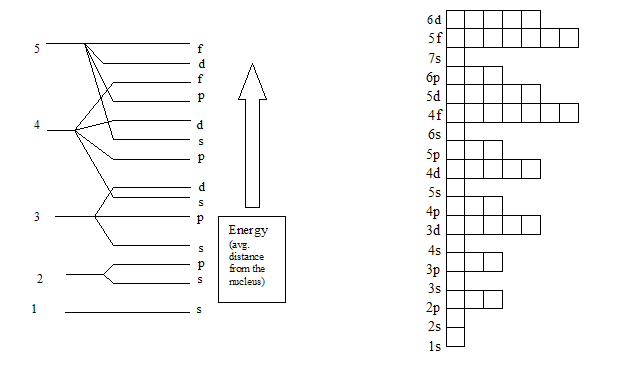
As we get to elements with
greater numbers of electrons, there is quite a bit of
overlapping of orbitals between 2 and 3 different
principal energy levels.
Without experience, it is difficult to determine
the order in which
the orbitals will be filled.
The diagram below, left, shows how this
overlapping of orbital energies distorts our nice
pattern we
started to see in the electron configurations.
Use the diagram below, right, to determine the
order of orbital filling, starting from the bottom.
Each box represents an orbital.

Based on this order of adding
electrons to atoms, which orbital will take the next
electron? It
must go into the “5s” orbital, so the ground state
electron configuration of the element rubidium is:
|
Rubidium |
1s22s22p63s23p64s23d104p65s1
|
Now,
this is becoming a lot of work writing down these
ever-expanding electron configurations!
The more electrons we have in the atom, the longer
the electron configuration.
We have a method we can use to simplify writing
these configuration as we become more familiar with them.
If we look closely, we notice that the electron
configuration for rubidium is the same as the previous
element, argon, with a single 5s electron added on.
For the electron configuration of argon, let us
simply write [Ar]. The
simplified electron configuration for rubidium then
becomes:
We
can do this for any element, BUT, we must use only
noble gases in the brackets.
I call this the noble
gas simplification.
In this method of writing electron configurations,
the last noble gas before we get to the element of
interest is the noble gas we put into the brackets.
For instance, for the element aluminum we write
|
Aluminum
|
[Ne]3s23p1
|
and for calcium we write |
|
Calcium
|
[Ar]4s2
|
|
We may NOT use any
element in the brackets, only noble gases.
This notation for writing electron configurations
helps us to highlight 2 different types of electrons in
the atom. Those
electrons in the brackets are called core
electrons. These
electrons do not participate in chemical reactions.
The electrons written after the noble gas in
brackets are called valence
electrons.
In many cases, “d” electrons will be present
after the last noble gas, as in the element manganese :
[Ar]4s23d5.
We typically do not consider “d” electrons as
valence electrons and therefore a more specific definition
is needed: valence
electrons are those electrons in the highest principal
energy level. These
electrons are important because they are the ones that are
gained, lost or shared in chemical reactions.
For the element aluminum, above, we see 2 electrons
in the 3s orbital and 1 electron in the 3p orbital, so
aluminum has a total of 3 valence electrons.
Using the same method, calcium has 2 valence
electrons. If
we look at the electron configuration for manganese again:
We might then say that
it has 2 valence electrons by one definition (highest
principal energy level) or 7 valence electrons by the
other (electrons written after the last noble gas).
In fact, both can be true.
For the transition metals, “d” electrons are
present and they may or may not act as valence electrons;
it depends on the situation and it is not straight
forward, so we will describe numbers of valence electrons
only for elements that are NOT transition metals.
It is very easy to
determine an atom’s
number of valence electrons in another way, from
the periodic table. Look
at the following table to see that we can tell the number
of valence electrons an element has by looking at the
group (vertical column) it belongs to on the periodic
table:
|
Group Number |
Group’s
Electron
Configuration |
Number
of
Valence
Electrons |
Example |
| 1 |
ns1 |
1 |
sodium |
| 2 |
ns2 |
2 |
magnesium |
| 13 |
ns2p1 |
3 |
aluminum |
| 14 |
ns2p2 |
4 |
silicon |
| 15 |
ns2p3 |
5 |
phosphorus |
| 16 |
ns2p4 |
6 |
sulfur |
| 17 |
ns2p5 |
7 |
chlorine |
| 18 |
ns2p6 |
8 |
argon |
The number of valence electrons an element has will
become useful when we talk about chemical bonding.
Next-->Electron
Configurations and the Peridic Table
|