 Custom Search Electrons and Sublevels Electron Configurations and the Periodic Table Writing Electron Configurations Box and Arrow Configurations using Pauli Exclusion Principle and Hund's Rule Quantum Numbers
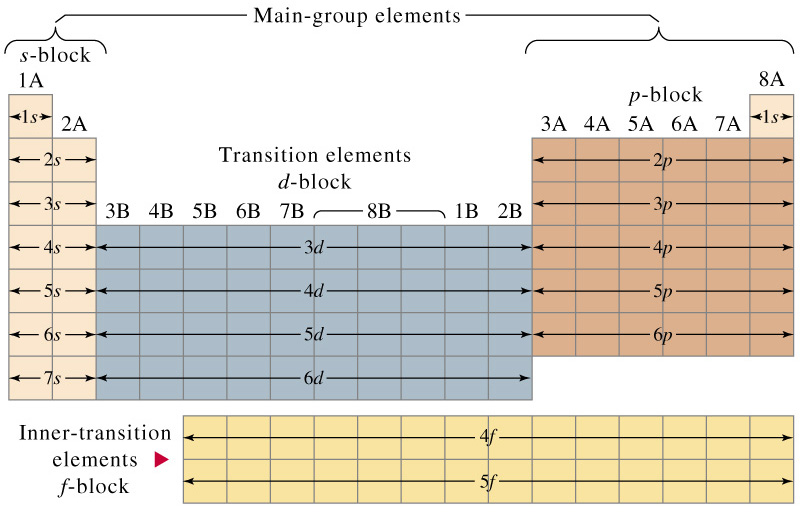
Electron configurations and the periodic table It will be helpful now to look at electron configurations also in the context of the periodic table. The periodic table can be broken into “blocks” that show what the last electron added to the electron configuration is.
The alkali metal electron configurations (group 1) always end with “s1” and the alkaline earth metals (group 2) always end with “s2”. These 2 groups are know as “s block” elements. “P block” elements are all those in groups 13-18 and always end with 1 or more “p” electrons. For example, all the elements in group 13, beginning with boron, end with “p1”. All of the elements in group 16, beginning with oxygen, end with “p4”. The transition elements are called “d block” elements and always end with 1 or more “d electrons”. For example, the all of the elements in group 3 beginning with scandium, all end in “d1”. The “f block” elements are those at the bottom of the periodic table that we call the lanthanide and actinide groups. These elements’ electron configurations always end with one or more “f electrons.” on to Electron Configurations Electrons and Sublevels Electron Configurations and the Periodic Table Writing Electron Configurations Box and Arrow Configurations using Pauli Exclusion Principle and Hund's Rule Quantum Numbers |