Questions | Answer | Explanations |
| 31 According to Table N, which radioactive isotope is best for determining the actual age of Earth? (1) 238 U (3)60 Co | 1 | the earth is old the one with the largest halflife |
32 Given the following solutions:
Which list has the solutions placed in order of increasing H + concentration?
| 1 | H= is referring to acidity high pH is a base low pH is acidic |
| 33 Which statement explains why nuclear waste materials may pose a problem?
| 4 | it is dangerous if it doesn't go away |
| 34 A compound whose water solution conducts electricity and turns phenolphthalein pink is
| 3 | pink is a base
|
35 Which of the following solids has the highest melting point?
| 2 | Ionic high melting point |
| 36 Hydrogen has three isotopes with mass numbers of 1, 2, and 3 and has an average atomic mass of 1.00794 amu. This information indicates that
| 3 | atomic mass is a weighed average and is closest to the most abundant isotope |
37 Which list of elements contains two metalloids?
| 1 | Si Ge |
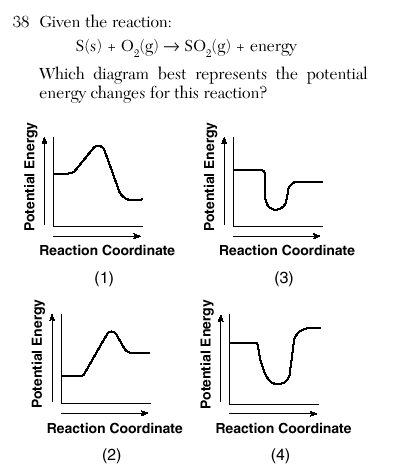 | 1 | energy is a product so it is exothermic |
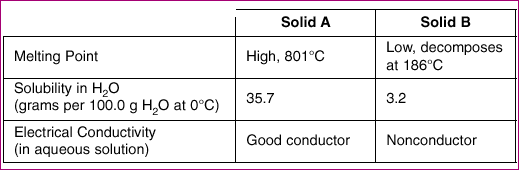
| 39 A chemist performs the same tests on two homogeneous white crystalline solids, A and B. The results are shown in the table below.
The results of these tests suggest that
| 4 | Solid A the properties of an ionic compound Solid B the properties of a covalent molecule |
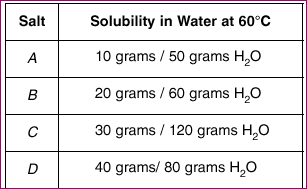
| 40 Solubility data for four different salts in water at 60°C are shown in the table below. Which salt is most soluble at 60°C?
| 4 | divide D =0.50g/mL |