Vapor pressure is determined by temperature, not by quantity of the liquid.
Boiling occurs when the vapor pressure of a liquid equals the atmospheric pressure above that liquid.
So, depending on the atmospheric pressure, a liquid can have many boiling points.
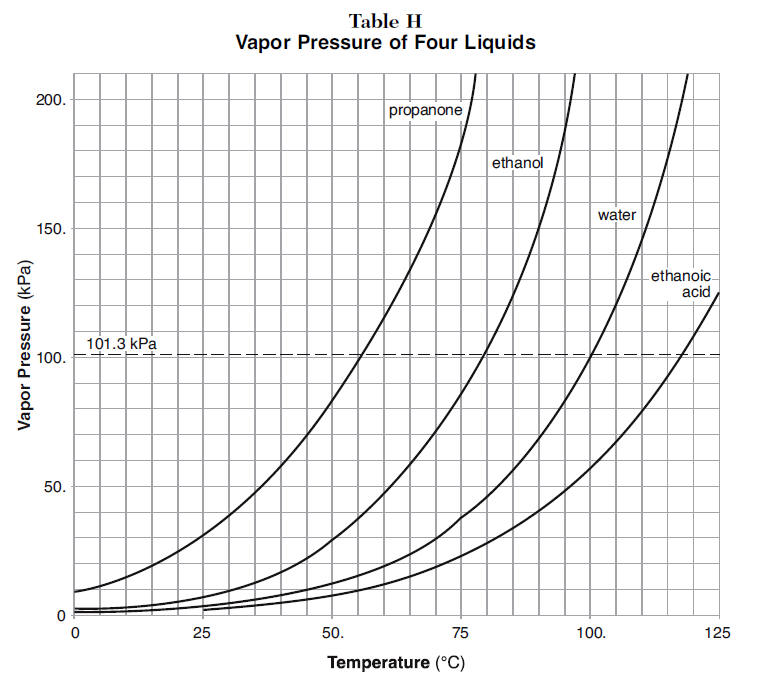
Water for example, boils at 100oC...at 101.3kPa.
(Common misconception is water always boils at 100oC)
If we lower the atmospheric pressure, water does not need as much energy (temperature) to overcome the atmospheric pressure above the liquid.
Therefore, the boiling point of water will be lower.
Example- Lowering the atmospheric pressure to 50kPa, will change waters boiling point to about 78oC.
Intermolecular Forces (IMF's) and Boiling Point- When comparing IMF's, the higher the boiling point the stronger the IMF's. It requires more energy to break the attractive forces between molecules, therefore a higher boiling point.
On Table H, ethanoic acid has the strongest IMF's. It has the highest boiling point ( due to it having the lowest vapor pressure).
Demo #1- Hot water is sealed in a flask and allowed to cool. If the pressure above the liquid is lowered by lowering the temperature of the gas above the liquid (using ice) the water will boil.
Demo #2- Warm water is placed into a vacuum chamber. The pressure is lowered and the water starts to boil.
Highlight box to reveal answers and explanations
Regents Questions
Answers
Explanations
June 2004-41 Using your knowledge of chemistry and the information in Reference Table H, which statement concerning propanone and water at 50°C is true?
(1) Propanone has a higher vapor pressure and stronger intermolecular forces than water. (2) Propanone has a higher vapor pressure and weaker intermolecular forces than water. (3) Propanone has a lower vapor pressure and stronger intermolecular forces than water. (4) Propanone has a lower vapor pressure and weaker intermolecular forces than water.
2
more vapor weaker intermolecular forces
Aug 2002-28 As the pressure on the surface of a liquid decreases, the temperature at which the liquid will boil (1) decreases (2) increases (3) remains the same
1
less pressure lower BP, table H
Aug 2007-16 Which liquid has the highest vapor pressure at 75°C? (1) ethanoic acid (3) propanone (2) ethanol (4) water
3
Table H
June 2008-14 Which liquid has the lowest vapor pressure at 65°C? (1) ethanoic acid (3) propanone (2) ethanol (4) water
1
Table H
June 2010-39 Which compound has the lowest vapor pressure at 50°C? (1) ethanoic acid (3) propanone (2) ethanol (4) water