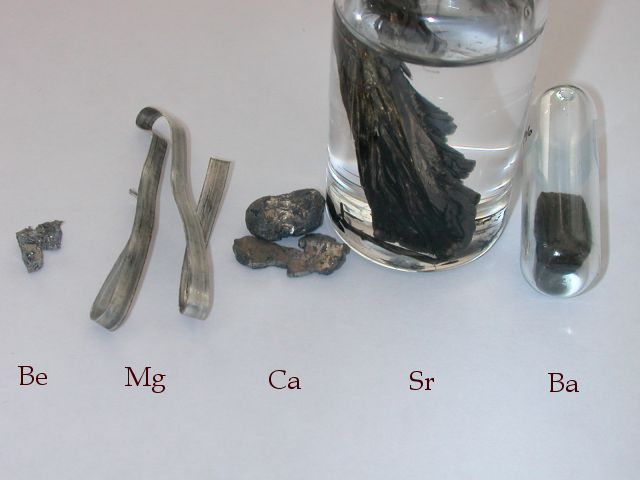
Beryllium is a chemical element with the symbol Be and atomic number 4. A bivalent element, beryllium is a steel grey, strong, light-weight yet brittle, alkaline earth metal. It is primarily used as a hardening agent in alloys, most notably beryllium copper.
It has one of the highest melting points of the light metals. The modulus of elasticity of beryllium is approximately a third greater than that of steel. It has excellent thermal conductivity and is nonmagnetic.
from- Wikipedia
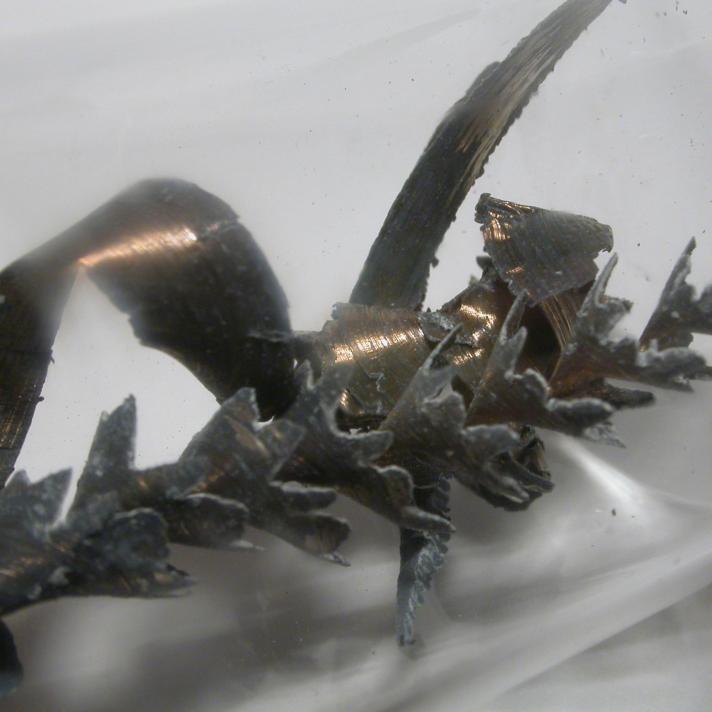
Magnesium
Magnesium metal and alloys are highly flammable in their pure form when molten, as a powder, or in ribbon form. Burning or molten magnesium metal reacts violently with water. Magnesium powder is an explosive hazard. One should wear safety glasses while working with magnesium, and if burning it, these should include a heavy U.V. filter, similar to welding eye protection. The bright white light (including ultraviolet) produced by burning magnesium can permanently damage the retinas of the eyes, similar to welding arc burns.[4]
Water should not be used to extinguish magnesium fires, because it can produce hydrogen which will feed the fire.
Carbon dioxide fire extinguishers should not be used either, because magnesium can burn in carbon dioxide (forming magnesium oxide, MgO, and carbon). A Class D dry chemical fire extinguisher should be used if available, or else the fire should be covered with sand or magnesium foundry flux. An easy way to put out small metal fires is to place a polyethylene bag filled with dry sand on top of the fire. The heat of the fire will melt the bag and the sand will flow out onto the fire.
from-wikipedia
Dry Ice and Magnesium Reaction
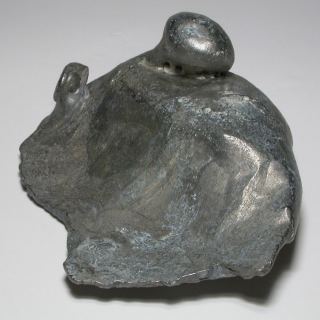
Calcium
Calcium is a soft grey alkaline earth metal, and is the fifth most abundant element in the Earth's crust. It is essential for living organisms, particularly in cell physiology, and is the most common metal in many animals.
Chemically calcium is reactive and moderately soft for a metal (though harder than lead, it can be cut with a knife with difficulty). It is a silvery metallic element that must be extracted by electrolysis from a fused salt like calcium chloride.[1] Once produced, it rapidly forms a grey-white oxide and nitride coating when exposed to air. It is somewhat difficult to ignite, in character rather like magnesium, but when lit, the metal burns in air with a brilliant high-intensity red light. Calcium metal reacts with water, evolving hydrogen gas at a rate rapid enough to be noticeable (unlike its sister magnesium) but not fast enough at room temperature to generate much heat. Part of the slowness of the calcium-water reaction results from the metal being partly protected by insoluble white calcium hydroxide. In water solutions of acids where the salt is water soluble, calcium reacts vigorously.
from-wikipedia
Strontium
An alkaline earth metal, strontium is a soft silver-white or yellowish metallic element that is highly reactive chemically. The metal turns yellow when exposed to air.
Due to its extreme reactivity to air, this element occurs naturally only in compounds with other elements, as in the minerals strontianite and celestite.
In its pure form strontium is extremely reactive with air and spontaneously combusts. It is therefore considered to be a fire hazard.
The human body absorbs strontium as if it were calcium. Due to the elements being sufficiently similar chemically, the stable forms of strontium do not pose a significant health threat, but the radioactive 90Sr can lead to various bone disorders and diseases, including bone cancer.
from-wikipedia
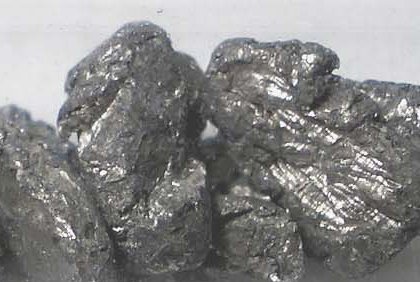
Barium
Barium is a soft silvery metallic alkaline earth metal. It is never found in nature in its pure form due to its reactivity with air. Its oxide is historically known as baryta but it reacts with water and carbon dioxide and is not found as a mineral.
Barium is a metallic element that is chemically similar to calcium but more reactive. This metal oxidizes very easily when exposed to air and is highly reactive with water or alcohol, producing hydrogen gas. Burning in air or oxygen produces not just barium oxide (BaO) but also the peroxide. Simple compounds of this heavy element are notable for their high specific gravity. This is true of the most common barium-bearing mineral, its sulfate barite BaSO4, also called 'heavy spar' due to the high density (4.5 g/cm³).
All water or acid soluble barium compounds are extremely poisonous. At low doses, barium acts as a muscle stimulant, while higher doses affect the nervous system, causing cardiac irregularities, tremors, weakness, anxiety, dyspnea and paralysis. This may be due to its ability to block potassium ion channels which are critical to the proper function of the nervous system.
Radium
Radium was discovered by Marie Sklodowska Curie, a Polish chemist, and Pierre Curie, a French chemist, in 1898. Marie Curie obtained radium from pitchblende, a material that contains uranium, after noticing that unrefined pitchblende was more radioactive than the uranium that was separated from it. She reasoned that pitchblende must contain at least one other radioactive element. Curie needed to refine several tons of pitchblende in order to obtain tiny amounts of radium and polonium, another radioactive element discovered by Curie. One ton of uranium ore contains only about 0.14 grams of radium. Today, radium can be obtained as a byproduct of refining uranium and is usually sold as radium chloride (RaCl2) or radium bromide (RaBr2) and not as a pure material.
Radium had been used to make self-luminous paints for watches, aircraft instrument dials and other instrumentation, but has largely been replaced by cobalt-60, a less dangerous radioactive source. A mixture of radium and beryllium will emit neutrons and is used as a neutron source. Radium is used to produce radon, a radioactive gas used to treat some types of cancer. A single gram of radium-226 will produce 0.000l milliliters of radon a day.
Radium is about one million times more active than uranium. The lab notebooks used by the Curies are too highly contaminated to be safely handled today.


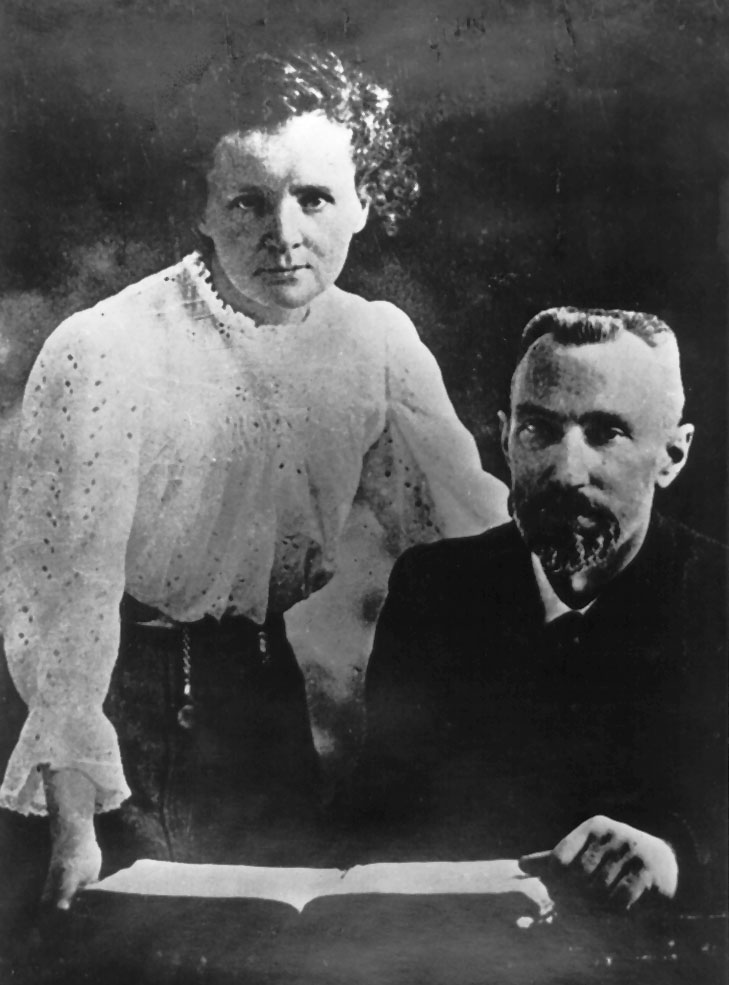 Radium was discovered by Marie Sklodowska Curie, a Polish chemist, and Pierre Curie, a French chemist, in 1898. Marie Curie obtained radium from pitchblende, a material that contains uranium, after noticing that unrefined pitchblende was more radioactive than the uranium that was separated from it. She reasoned that pitchblende must contain at least one other radioactive element. Curie needed to refine several tons of pitchblende in order to obtain tiny amounts of radium and polonium, another radioactive element discovered by Curie. One ton of uranium ore contains only about 0.14 grams of radium. Today, radium can be obtained as a byproduct of refining uranium and is usually sold as radium chloride (RaCl2) or radium bromide (RaBr2) and not as a pure material.