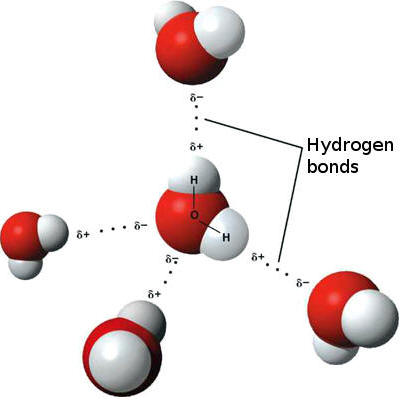
Hydrogen bonds occur between molecules that have a
permanent net dipole resulting from hydrogen being
covalently bonded to either fluorine, oxygen or
nitrogen. For example, hydrogen bonds operate between
water (H2O) molecules, ammonia (NH3)
molecules, hydrogen fluoride (HF) molecules, hydrogen
peroxide (H2O2) molecules,
alkanols (alcohols) such as methanol (CH3OH)
molecules, and between alkanoic (caboxylic) acids such
as ethanoic (acetic) acid (CH3COOH) and
between organic amines such as methanamine (methyl
amine, CH3NH2).
Are a stronger intermolecular force than either
Dispersion forces or dipole-dipole interactions since
the hydrogen nucleus is extremely small and positively
charged and fluorine, oxygen and nitrogen being very
electronegative so that the electron on the hydrogen
atom is strongly attracted to the fluorine, oxygen or
nitrogen atom, leaving a highly localised positive
charge on the hydrogen atom and highly negative
localised charge on the fluorine, oxygen or nitrogen
atom. This means the electrostatic attraction between
these molecules will be greater than for the polar
molecules that do not have hydrogen covalently bonded to
either fluorine, oxygen or nitrogen.
from-http://www.ausetute.com.au/intermof.html
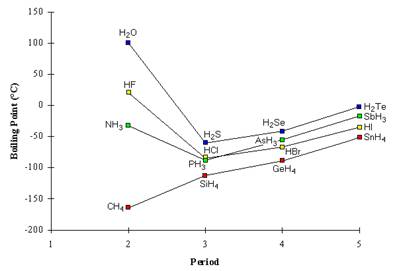
If only dispersion forces are present,
then the more electrons the molecule has (and
consequently the more mass it has) the stronger the
dispersion forces will be, so the higher the melting and
boiling points will be. Consider the hydrides of Group
IV, all of which are non-polar molecules, so only
dispersion forces act between the molecules. CH4
(molecular mass ~ 16), SiH4 (molecular mass ~ 32), GeH4
(molecular mass ~ 77) and SnH4 (molecular mass ~ 123)
can all be considered non-polar covalent molecules. As
the mass of the molecules increases, so does the
strength of the dispersion force acting between the
molecules, so more energy is required to weaken the
attraction between the molecules resulting in higher
boiling points.
If a covalent molecule has a permanent
net dipole then the force of attraction between these
molecules will be stronger than if only dispersion
forces were present between the molecules. As a
consequence, this substance will have a higher melting
or boiling point than similar molecules that are
non-polar in nature. Consider the boiling points of the
hydrides of Group VII elements. All of the molecules HF
(molecular mass ~ 20), HCl (molecular mass ~ 37), HBr
(molecular mass ~ 81) and HI (molecular mass ~ 128) are
polar, the hydrogen atom having a partial positive
charge (H)
and the halogen atom having a partial negative charge (F,
Cl,
Br,
I).
As a consequence, the stronger dipole-interactions
acting between the hydride molecules of Group VII
elements results in higher boiling points than for the
hydrides of Group IV elements as seen above. With the
exception of HF, as the molecular mass increases, the
boiling point of the hydrides increase. HF is an
exception because of the stronger force of attraction
between HF molecules resulting from hydrogen bonds
acting between the HF molecules. Weaker dipole-dipole
interactions act between the molecules of HCl, HBr and
HI. So HF has a higher boiling point than the other
molecules in this series.