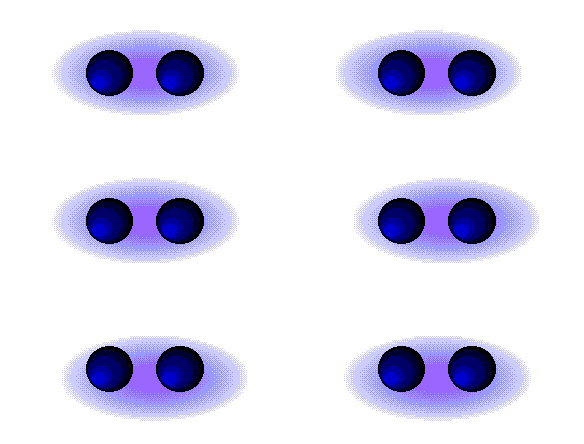
van der Waals Forces (London Forces(Fritz London 1930), Weak Intermolecular Forces)
are very weak forces of attraction between molecules resulting
from:
momentary dipoles occurring due to uneven electron
distributions in neighbouring molecules as they approach one
another
the weak residual attraction of the nuclei in one
molecule for the electrons in a neighbouring molecule.
The more electrons that are present in the molecule, the stronger
the dispersion forces will be.
Dispersion forces are the only type of intermolecular force
operating between non-polar molecules, for example, dispersion
forces operate between
hydrogen (H2) molecules
chlorine (Cl2) molecules
carbon dioxide (CO2) molecules
dinitrogen tetroxide (N2O4) molecules
methane (CH4) molecules
from-http://www.ausetute.com.au/intermof.html
More Complex Explanation
The attractive forces that exist between molecules
are responsible for many of the bulk physical properties exhibited
by substances. Some compounds are gases, some are liquids, and
others are solids. The melting and boiling points of pure substances
reflect these intermolecular forces, and are commonly used for
identification. Of these two, the boiling point is considered the
most representative measure of general intermolecular attractions.
Thus, a melting point reflects the thermal energy needed to convert
the highly ordered array of molecules in a crystal lattice to the
randomness of a liquid. The distance between molecules in a crystal
lattice is small and regular, with intermolecular forces serving to
constrain the motion of the molecules more severely than in the
liquid state. Molecular size is important, but shape is also
critical, since individual molecules need to fit together
cooperatively for the attractive lattice forces to be large.
Spherically shaped molecules generally have relatively high melting
points, which in some cases approach the boiling point, reflecting
the fact that spheres can pack together more closely than other
shapes. This structure or shape sensitivity is one of the reasons
that melting points are widely used to identify specific compounds.
Boiling points, on the other hand, essentially reflect the kinetic
energy needed to release a molecule from the cooperative attractions
of the liquid state so that it becomes an unincumbered and relative
independent gaseous state species. All atoms and molecules have a
weak attraction for one another, known as van der Waals
attraction. This attractive force has its origin in the
electrostatic attraction of the electrons of one molecule or atom
for the nuclei of another, and has been called London dispersion
force.
The following animation illustrates how close approach of two neon
atoms may perturb their electron distributions in a manner that
induces dipole attraction. The induced dipoles are transient, but
are sufficient to permit liquifaction of neon at low temperature and
high pressure.
In general, larger molecules have higher boiling
points than smaller molecules of the same kind, indicating that
dispersion forces increase with mass, number of electrons, number of
atoms or some combination thereof. The following table lists the
boiling points of an assortment of elements and covalent compounds
composed of molecules lacking a permanent dipole. The number of
electrons in each species is noted in the first column, and the mass
of each is given as a superscript number preceding the formula.
Two ten electron molecules are shown in the first row. Neon is
heavier than methane, but it boils 84ē lower. Methane is composed
of five atoms, and the additional nuclei may provide greater
opportunity for induced dipole formation as other molecules
approach. The ease with which the electrons of a molecule, atom or
ion are displaced by a neighboring charge is called polarizability,
so we may conclude that methane is more polarizable than neon. In
the second row, four eighteen electron molecules are listed. Most of
their boiling points are higher than the ten electron compounds neon
and methane, but fluorine is an exception, boiling 25ē below
methane. The remaining examples in the table conform to the
correlation of boiling point with total electrons and number of
nuclei, but fluorine containing molecules remain an exception.
The anomalous behavior of fluorine may be attributed to its very
high electronegativity. The fluorine nucleus exerts such a strong
attraction for its electrons that they are much less polarizable
than the electrons of most other atoms.
Of course, boiling point relationships may be dominated by even
stronger attractive forces, such as those involving electrostatic
attraction between oppositely charged ionic species, and between the
partial charge separations of molecular dipoles. Molecules having a
permanent dipole moment should therefore have higher boiling points
than equivalent nonpolar compounds, as illustrated by the data in
the following table.
In the first row of compounds, ethane, ethene and ethyne have no
molecular dipole, and serve as useful references for single, double
and triple bonded derivatives that do. Formaldehyde and hydrogen
cyanide clearly show the enhanced intermolecular attraction
resulting from a permanent dipole. Methyl fluoride is anomalous, as
are most organofluorine compounds. In the second and third rows, all
the compounds have permanent dipoles, but those associated with the
hydrocarbons (first two compounds in each case) are very small.
Large molecular dipoles come chiefly from bonds to
high-electronegative atoms (relative to carbon and hydrogen),
especially if they are double or triple bonds. Thus, aldehydes,
ketones and nitriles tend to be higher boiling than equivalently
sized hydrocarbons and alkyl halides. The atypical behavior of
fluorine compounds is unexpected in view of the large
electronegativity difference between carbon and fluorine.
Johannes
Van der Waals was interested in the kinetic theory of
gases and fluids, and his primary work was to develop an
equation which applied to real gases, unlike that of
Robert Boyle which assumes that there are no attractive
forces between molecule and that molecules have zero
volume.
In reality, molecules have a small volume and attractive
forces exist between them. Van der Waals introduced
these properties into the theory by means of two
constants, which were specific to each gas:
(P
+ a/v2)(v-b) = RT, where a and b are constant
for a particular gas.
Van
der Waals was awarded a Nobel prize in 1910 for his work
on the equation of state of gases and liquids.
The
weak, electrostatic attractions between atoms were named
Van der Waals forces in his honour.