 Custom Search Back to Acid Base Links
pH=-log[H+] Definition from wiki- pH is a measure of the acidity or alkalinity of a solution. Solutions with a pH less than seven are considered acidic, while those with a pH greater than seven are considered basic (alkaline). pH 7 is considered neutral because it is the pH of pure water at 25 °C. pH is formally dependent upon the activity of hydrogen ions (H+), but for very pure dilute solutions, the molarity may be used as a substitute with some sacrifice of accuracy. Because pH is dependent on activity, a property which cannot be measured easily or predicted theoretically, it is difficult to determine an accurate value for the pH of a solution. The pH reading of a solution is usually obtained by comparing unknown solutions to those of known pH, and there are several ways of doing this. The concept of pH was first introduced by Danish chemist S. P. L. Sørensen. The name, pH, has been purported to come from a variety of places including: pondus hydrogenii (Latin),potentiel hydrogène (French), and potential of hydrogen (English). However pH is actually a shorthand for its mathematical approximation: in chemistry a small p is used in place of writing - log10 and the H should more correctly be [H+], standing for concentration of hydrogen ions.
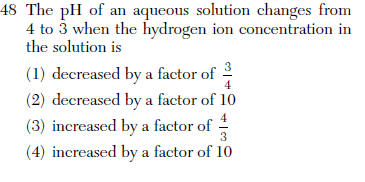
Past Regents Problems involving pH Jan 2004-25 Which of these pH numbers indicates the highest Aug 2010-9 A solution with a pH of 2.0 has a hydronium ion concentration ten times greater than a solution with a pH of Aug 2007-48 What is the pH of a solution that has a hydronium ion concentration 100 times greater than a solution with a pH of 4? Aug 2006-50 Solution A has a pH of 3 and solution Z has a pH of 6. How many times greater is the Aug 2003-28. When the pH of a solution changes from a pH of 5 to a pH of 3, the hydronium ion concentration is A. 0.01 of the original content
Jan 2007-48 As the pH of a solution is changed from 3 to 6, the concentration of hydronium ions Aug 2004-30 Which pH change represents a hundredfold increase in the concentration of H+? 1) pH 5 to pH 7 (3) pH 3 to pH 1 (2) pH 13 to pH 14 (4) pH 4 to pH 3 June 2009-47 Which change in pH represents a hundredfold increase in the concentration of hydronium ions in a solution? Aug 2004-48 Which statement correctly describes a solution with a pH of 9? (1) It has a higher concentration of H3O+ than OH– and causes litmus to turn blue. (2) It has a higher concentration of OH– than H3O+ and causes litmus to turn blue. (3) It has a higher concentration of H3O+ than OH– and causes methyl orange to turn yellow. (4) It has a higher concentration of OH– than H3O+ and causes methyl orange to turn red. Back to Acid Base Links |