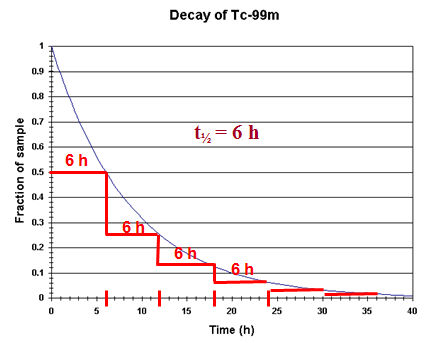
Atoms decay by transforming protons and neutrons into other particles. This decay process is predictable in that we can determine how many atoms will decay over a given period of time, we just don't know which atoms will decay. Half-life is the time it takes for half of the original sample of radioactive nuclei to decay. Half-life is a statistical model. The number of decay is not completely regular, but on average the number of decays for a particular isotope is consistent.
500g of X going through 6 half-lives
500 g250 g125 g62.5 g31.25 g15.625 g7.8125 g
half-life
0
1
2
3
4
5
6
7
8
fraction
remaining
1
1/2
1/4
1/8
1/16
1/32
1/64
1/128
1/256
graphing examples
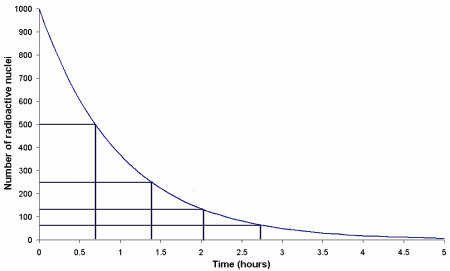
This plot shows how the number of radioactive nuclei in a sample falls with time. After 0.7 hours the original number of 1000 active nuclei has fallen to 500. The strength of the source has accordingly fallen in half. Of the remaining active nuclei a further half will have decayed in the following 0.7 hours leaving only 250 and so on down to 125 after 2.1 hours. The time taken for the strength of the source to fall in half is called the half-life and depends only on the particular element involved and exactly how unstable it is.
How to do some calculations.
Past Regents Questions
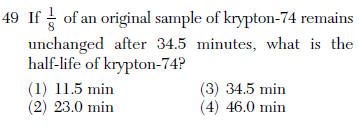
Jan 2004-47 After 32 days, 5 milligrams of an 80-milligram sample of a radioactive isotope remains unchanged. What is the half-life of this element? (1) 8 days (3) 16 days (2) 2 days (4) 4 days
June 2008-50 An original sample of K-40 has a mass of 25.00 grams. After 3.9 × 10⁹years, 3.125 grams of the original sample remains unchanged. What is the half-life of K-40? (1) 1.3 × 10⁹y (3) 3.9 × 10⁹y (2) 2.6 × 10⁹y (4) 1.2 × 10¹⁰y
June 2006-49 What is the half-life of sodium-25 if 1.00 gram of a 16.00-gram sample of sodium-25 remains unchanged after 237 seconds? (1) 47.4 s (3) 79.0 s (2) 59.3 s (4) 118 s
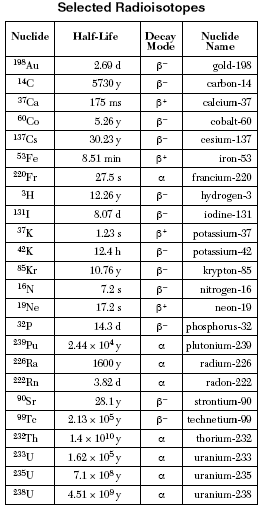
Jun 2005-29 What is the half-life and decay mode of Rn-222? (1) 1.91 days and alpha decay (2) 1.91 days and beta decay (3) 3.82 days and alpha decay (4) 3.82 days and beta decay


 250 g
250 g 125 g
125 g 62.5 g
 31.25 g
 15.625 g
 7.8125 g