The various components of crude oil have different sizes, weights and boiling temperatures; so, the first step is to separate these components. Because they have different boiling temperatures, they can be separated easily by a process called fractional distillation. The steps of fractional distillation are as follows: fractional distillation
You heat the mixture of two or more substances (liquids) with different boiling points to a high temperature. Heating is usually done with high pressure steam to temperatures of about 1112 degrees Fahrenheit / 600 degrees Celsius.
The mixture boils, forming vapor (gases); most substances go into the vapor phase.
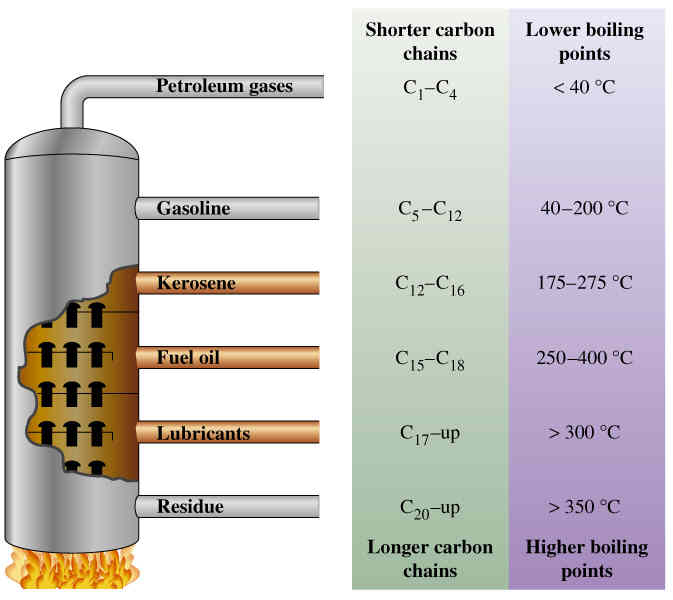
The vapor enters the bottom of a long column (fractional distillation column) that is filled with trays or plates.
The trays have many holes or bubble caps (like a loosened cap on a soda bottle) in them to allow the vapor to pass through.
The trays increase the contact time between the vapor and the liquids in the column.
The trays help to collect liquids that form at various heights in the column.
There is a temperature difference across the column (hot at the bottom, cool at the top).
The vapor rises in the column.
As the vapor rises through the trays in the column, it cools.
When a substance in the vapor reaches a height where the temperature of the column is equal to that substance's boiling point, it will condense to form a liquid. (The substance with the lowest boiling point will condense at the highest point in the column; substances with higher boiling points will condense lower in the column.).
The trays collect the various liquid fractions.
The collected liquid fractions may:
pass to condensers, which cool them further, and then go to storage tanks
go to other areas for further chemical processing
Fractional distillation is useful for separating a mixture of substances with narrow differences in boiling points, and is the most important step in the refining process.
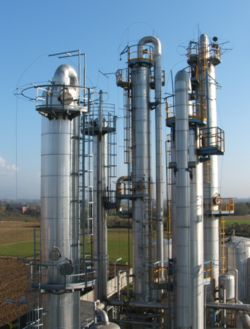
The oil refining process starts with a fractional distillation column. On the above you can see several chemical processors that are described in the next section.